Showing posts with label Folklore.. Show all posts

Tuesday, February 25, 2014

Poteen. The Pot of Gold at the end of a rainbow.


It has been said that poteen has been produced in Ireland ever since the first potato was plucked from the ground. The name Poteen means little pot and is supposed to reflect its small scale production. You know maybe it’s that pot of gold that you may find at the end of a rainbow.

Poteen.

According to legend St. Patrick was said to have been responsible for introducing poteen to Ireland in the fifth century A.D.  Having run out of mass wine he brewed up the first batch of poteen. However, I would suggest that this is a complete fabrication and has more to do with the fact that Christian monks recorded the practice of poteen making in written form and as with a lot of other urban myths concerning St Patrick it has become part of Irish folklore.

In fact one of the earliest records of distilling aqua vitae or the water of life also has a religious connection. In the Exchequer Rolls of 1494 it was recorded that eight bolls of malt were delivered to Friar John Cor to make whiskey. Distilled spirits were commonly made in monasteries for medical purposes and were often prescribed for the preservation of good health and as a general cure all.

 There were monastic distilleries recorded in Ireland in the late 12th century.  The medical benefits were formally endorsed in 1505 when the Guild of Surgeon Barbers was granted a monopoly over the manufacture of aqua vitae which they used when carrying out surgical procedures.

Of course there have been many in the medical profession who have condemned poteen as highly dangerous and warn of the very real threat of alcoholic poisoning and they also claim that it was responsible for a huge problem with alcoholism in rural Ireland.

 They also pointed out the increase in mental illness and it was suggested at one time that more than half the people in the mental asylum in County Mayo were there from the effects of poteen drinking.  However, in 1730, one doctor claimed that drinking poteen to the point of intoxication held off old-age, aided digestion, enlightened the heart, and quickened the mind.  I would not recommend this advice folks.

In Ireland we hold a wake for someone who has died and one suggestion for this was said to be because of the after effects of poteen. It was said that people didn’t know if those who were lay as if dead were just unconscious or were actually dead so they used to wait up at night for them to wake up, hence the name.  A more recent story which is probably a myth is that it was called a wake because of the frequent lead poisoning suffered by people drinking from pewter tankards.  One of the symptoms of lead poisoning is that of a catatonic state that resembles death from which you would hopefully recover in anything from a few hours to a couple of days.  It was for this reason that a burial was delayed to give the poor unfortunate a chance to wake up.  I’d make your own mind up about that one.

It was in1661 that King Charles II, attempting to re-build the post-war treasury, decided to introduce a charge on spirits. In Ireland private stills were outlawed and a large section of the Irish population became criminals at the stroke of a pen.  The Irish promptly ignored the tax and the making of poteen was forced to go underground.  In 1770, the English tried to clamp down on the trade once again but it did very little to slow down production and poteen making took off as a thriving cottage industry.

The stills were moved from cottage to barn then to small shacks in the hills and mountains.  Some enterprising individuals set up stills in ancient burial chambers (I wonder if that’s why they are called spirits), some set up on small islands in the middle of lakes, so they could see the gards coming and one fellow even had his still set up on a small boat on a Lough. It was said that for many years he was able to out row the local Gardaí.

There is a wealth of folklore regarding poteen.

Leprechauns are frequently found in a drunken state caused by poteen.

Poteen made in fairy mounds is seen as magical and it was used for curing painful rheumatic joints, half a cup given morning and night was said to be a cure for all ailments.

It is said to be especially potent if a housewife left fresh cream and bread by a fairy mound at night and asked the fairies for a cure for illness. The fairies would then leave a cup of poteen outside the cottage door to heal the sick.

Poteen made from the water of a fairy spring or sacred well also gave it healing properties and it was used by wise women like Biddy Early in medicinal cures.

Drinking poteen on a fairy hill at night will call the fairies to you and in exchange for a drink they are said to grant you a wish in return. However, give them too much and you may end up as their permanent guest.  Drinking poteen is also said to be responsible for hallucinations. I’m saying nothing.

The Achill Islanders once referred to poteen simply as Inishkea because of its superior quality and flavour.  In fact they suggested that the Islanders of Inishkea should be declared Saints because of their skill.  The reasons given for the quality of this illegal produce included the remote location of Inishkea which enabled the still owners to take their time in distilling the alcohol without fear of interruption by the Custom’s man or the Gardái, well you should never hurry a good thing.  The Island is located off the Mayo coast, because of the changes in the weather the law enforcers may have a calm trip out but then be stuck there for a week due to heavy seas and wind conditions.

Another reason for superior poteen was that it was distilled in copper stills which were far better than the tin stills used on the mainland. These stills were often hidden in the caves on the western side of the Island well away from the prying eyes of unwelcome visitors and they were so valuable they were handed down from father to son.

Inishkea Islanders had a very limited source of income, fishing and poteen provided them with products that could be sold or traded on the mainland and once again the sale of poteen found willing buyers within the clergy (both Catholic and Protestant), and Gardái.  There were always customers on Achill Island who eagerly awaited a new batch of poteen unfortunately this was to lead to a great tragedy in 1898 when an Inishkea Islander and his daughter were lost at sea when rowing to Achill with a cargo of poteen. This led to three members of the R.I.C. (Royal Irish Constabulary) to be stationed on the Island.

Eventually the church declared the drinking of poteen a sin, the Bishop of Clogher , Most Rev. Dr. O’Callaghan declared it to be a product that led to smuggling and blamed all the troubles of Ireland on its consumption.  One man arrested for its production said “The devil drove me to it yer Honour”, he was convicted and fined a total of £33.  On another occasion a shocked priest said to a parishioner “I am told you sold it for £2, aren’t you ashamed of yourself?” To which the answer came “Sure Father it was all I could get”.  Or was that for selling his vote to the Landlord?  There’s an old saying in Ireland “Never let the truth stand in the way of a good story”.  There I will leave the Islands of Inishkea.

Tuesday, February 19, 2013


The legend of the Snowdrop.

Adam and Eve were kicked out of the Garden of Eden, a place where the sun shone every day, where they were warm and happy and had everything they could possibly wish for or want.  Unfortunately for them it was winter when they landed on earth, heavy rain, cold winds and dark grey skies. Eve spent every moment shivering, something she had never experienced before, she never needed to wear clothes, she didn’t even know what clothes were.  It was so cold that she felt as if her blood was beginning to freeze, and then the snow began to fall.  

At first the snow looked so pretty but that soon wore off, the blizzards made her eyes sting, her face hurt, her fingers were going numb and her body began to freeze.  Eve fell into a deep despair, would this cold never end, would she ever feel the warmth of the sun upon her face, would she ever feel warm again? She fell to her knees and began to cry. 

God hadn’t abandoned Adam and Eve completely, he had sent an angel to watch over them Upon seeing Eve kneeling in the snow in a state of deep despair sobbing her eyes out the angel asked her why she was so sad.  Eve told the angel that she despaired of ever feeling warm again, she had given up hope of ever seeing the sun, of ever being happy.  

The angel reached down and picked up a snowflake, gently she breathed on it and let it fall back to the frozen ground.  Every time she did this the snowflake turned into a small flower as white as the snow upon which it fell until Eve was surrounded by a carpet of small pure white flowers. 

“Why have you done this for me?” asked Eve,

The angel replied “To show you that winter will end, the flowers will bloom again and the sun will shine. This gift I give you is the gift of Hope”.

The flowers that the angel made became known as Snowdrop and they give us hope of a new spring, a new beginning, and new life.

So never give up for the sun will shine again tomorrow.

Keep smiling.

SilentOwl.

Saturday, January 5, 2013


The Dullahan.
“The Dullahan serves no master but death.”

The Irish Dullahan (also Gan Ceann.) is a type of unseelie faerie (dark faerie). He is a soul collector who roams the countryside during midnight on certain Irish festive days. He is dressed in a long black cloak and is headless, usually seen riding a black horse and carrying his head under one arm. The head's eyes are massive and constantly dart about like flies, while the mouth is constantly in a hideous grin that touches both sides of the head. In some of the stories his horse has a head too. Its head is longer than its body by 6 yards and has flaming eyes and short ears.

The flesh of the head is said to have the colour and consistency of mouldy cheese. He has a large mouth filled with razor sharp teeth filed to a point. The Dullahan whip is actually a human corpse's spine, and the wagons they sometimes use are black horse drawn hearses. When the Dullahan stops riding, it is where a person is due to die. The Dullahan calls out their name, at which point they immediately perish.

There is no way to bar the road against a Dullahan, all locks and gates open on their own when it approaches. Also, they do not appreciate being watched while on their errands, throwing a basin of blood on those who dare to do so (often a mark that they are among the next to die), or even lashing out the watchers' eyes with their whips. Nonetheless, they are frightened of gold, and even a single gold pin can drive a Dullahan away.

The Dullahan may have been the inspiration for The Legend of Sleepy Hollow.

W. J. Fitzpatrick, a famous storyteller claims to have seen a Dullahan. He recounts:
“I seen the Dullahan myself, stopping on the brow of the hill between Bryansford and Moneyscalp late one evening, just as the sun was setting. It was completely headless but it held up its own head in its hand and I heard it call out a name. I put my hand across my ears in case the name was my own, so I couldn't hear what it said. When I looked again, it was gone. But shortly afterwards, there was a bad car accident on that very hill and a young man was killed. It had been his name that the Dullahan was calling”.

In other legends he sides with the legendary ghost, the Banshee, and they drive a black cart (called the Coiste Bodhar, death coach) drawn by six black horses and whips them with his whip made of a human spinal cord. When he rides out on his own he uses the whip to pluck out the eyes out mortals foolish enough to spy on him during his nightly runs. It is said that the Dullahan hates those with sharp eyesight. The only fear he has is gold, which any lonely traveller at night would be wise to have to ward off him off.

It was once believed that the Dullahan was sent by the queen of the fairies to punish mortals that had betrayed the secrets of the fairie folk.  He would visit you as you slept and one touch of his hand would cause the muscles of your arm or leg to wither and die. He would then leave as silently as he came.
Some people believe that the Dullahan is the embodied spirit of a Celtic god, Crom Dubh, who demanded human sacrifices each year. The worship of Crom Dubh continued in Ireland until the sixth century, when Christian missionaries arrived from Scotland. However, Crom Dubh still wanting souls became the Dullahan or Far dorocha ( Dark Man.)

The Unseelie Court is the opposite of The Seelie Court.  Those that fly through the night are called The Host or The Horde.  It was said that any mortal unlucky enough to cross paths with The Host would be attacked and forced to participate in their nocturnal activities. The Unseelie court comprised of the most unholy, and evil of the fairies.  It has been suggested that the early Christian church invented these stories to stop pagans from participating in fertility rites at Beltaine and other important rituals at other times of the year (Samhain, etc).

“Faeries come take me out of this dull world,
For I would ride with you upon the wind,
Run on top of the dishevelled tide,
And dance upon the mountains like a flame.”
W.B. Yeats, The Land of Heart’s Desire.

Tuesday, January 1, 2013


The Sandman.

The first written record appears in 1861 in tales by Hans Christian Andersen.

In his short story "The Sandman," which appeared in a book called Die Nachtstücke (The Night Pieces), E.T.A. Hoffman wrote of the Sandman: Oh! he’s a wicked man, who comes to little children when they won’t go to bed and throws handfuls of sand in their eyes, so that they jump out of their heads all bloody; and he puts them in a bag and takes them to the half-moon as food for his little ones; and they sit there in the nest and have hooked beaks like owls, and they pick naughty little boys’ and girls’ eyes out with them. (Hoffman, E.T.A., "The Sandman." Fantastic Tales, ed. Italo Calvino, Random House, Inc., 1997, p. 37).  Watch video above.

The Sandman has become a benevolent character in modern day folklore but this has not always been the case. He was traditionally seen as helping children to go to sleep by sprinkling magic dust in their eyes. It was said that he brought them happy dreams and upon waking the ‘sleep’ in the corner of their eyes would be the result of the sand/dust he had sprinkled on them.

However, there is another Sandman quiet different from the one who is now portrayed. This Sandman wears the skin of corpses, smelling of death and decay. He has long bony fingers that end in extremely sharp nails and his foul mouth is full of razor sharp fangs. Hiding in the shadows he whispers to his victim; Tic toc, tic toc” slowly lulling them to sleep.  Once they have fell into a deep sleep the Sandman will leave the shadows and feed on the victim.  There is absolutely no mention of this malignant sandman in folklore but due to peoples appetite for gore it quickly caught on.  In Hans Christian Andersen original tale   Ole Lukoje there are also two versions of the Sandman, one who brings sweet dreams, the other who brings the sleep of death.

Why some people feel it necessary to use bedtime stories to terrify children into obedient behaviour is quite beyond me but it seems to be prevalent across many tales.

Others mentioned in European folklore are  TheDustman, Billy Winker or Wee Willie Winkie, Old Shut-eye  and Nanny Button-Cap. These night time visitors are said to move from house to house making sure that children go to sleep. However, they are not restricted to children as some adults wake up in the mornings with ‘sleep’ in their eyes.

I will continue to look for information on this creature as requested (manbehindthecurtain).  It is not really found in Irish folklore, nevertheless he is an interesting character.

Above video courtesy of youtube = The Sandman edited and directed by Paul Berry, 1992.
Keep smiling. Oh and by the way...Sweet dreams.
SilentOwl.

Sunday, December 30, 2012


The Sluagh.

The Sluagh are dead sinners that return as evil spirits that hunt for souls.  They come from the west, flying in groups like flocks of crows and attempt to enter the dwelling of someone who is close to death in order to steal their soul. It is for this reason that west-facing windows are kept shut at all times. This allows the soul of the deceased to reach heaven before the Sluagh can intercept it.  The Sluagh are well known in Ireland and Scotland and it was a name that brought terror to those who lay on their death beds.  Stories of who and what The Sluagh were date back through our folklore and these stories would be handed down from generation to generation. The stories may differ slightly but the bones of the story is always the same. Be wary of the shadow in the corner.

Once upon a time, long, long ago. In fact so long ago that only the storytellers remember it. Witches and Wizards walked among us and Fairies and Druids were not as rare as they are today.  Magic was in the air and the gods/goddesses were honoured and death was but another path upon the journey.  It was a time when the world was new and everything was possible.

Even then tales of The Sluagh were told. They were described as the souls of the darkest sinners, sinners so evil that not even the fires of the eternal flame would burn them. They were so evil that the underworld spat out their rotten souls and the earth rejected their very presence.  They were cursed to soar above the earth like a flock of birds welded together for eternity. Never to set foot or claw upon the ground.

The Sluagh is an Irish word meaning host, and they continued in their evil ways even after death.  Drifting on the westerly wind they would watch and wait until they felt a dying soul and if they found a door or window left slightly open, the evil souls would enter and linger in the shadows over the dying and wait. If you were sat nearby you may have even hear the eerie sound of whispers as The Sluagh sucked the soul from the weak and dying body.

  Once the stolen spirit was captured a terrified scream would echo from the shadows and continue through the night slowly becoming farther way before growing silent. The soul of the dying would now be joined to the unforgiving dead,  now they too were cursed to roam forever through the dark night. Damned to an eternity of sorrow, innocent or evil, any soul would do, it did not matter to The Sluagh.

The Sluagh were said to be bird like with long thin fingers that were webbed with leathery skin (a bit like a bat). They had caped like wings that flapped in the night and long claws that protruded from deformed legs. They were said to smell like rotten meat and it was the sound of beating wings together with this smell that alerted you to their presence. If you then heard a knock on the door or a nail scratching at the window you would be wise to ignore it. When darkness fell it often brought death. It always brought shadows.

In modern day Ireland stories are just that, stories, to be laughed at or viewed as entertainment. Nothing more than superstition or bedtime reading. Stories told by the storyteller sending children to sleep before the Sandman sprinkles his magic dust or the bogeyman crawls out to get you. However take a minute and answer me this. Have you ever lain in bed, watching shadows creep across the room, but there is no light to make shadows? Have you ever heard a far away shriek? Was it a cat, wait a minute. It didn’t sound like a cat, Oh I know, it must be an owl. Or was it?  What about the time you woke up from a deep sleep with that scary feeling that someone or something was watching you. Sometimes you wake up in the morning feeling more tired and drained than when you went to sleep, your head hurts, your limbs ache, you feel thirsty. You think you may be coming down with something for that’s what it feels like.

 Perhaps as you lay sleeping The Sluagh came for you. Remember the shadows on the ceiling or in the corner of your eye? When you looked again they weren’t there. Could it be that The Sluagh was feeding but hearing the sound of a weaker soul they left you sleeping? However now they know where you are, they can hear you breathing, lock your doors and keep your windows shut. Look to the west at night, are they flocks of crows returning home to roost...or something else.

 Once upon a midnight dreary, while I pondered, weak and weary,
Over many a quaint and curious volume of forgotten lore –
While I nodded, nearly napping, suddenly there came a tapping,
As of someone gently rapping, rapping at my chamber door –
"'Tis some visitor," I muttered, "tapping at my chamber door –
Only this and nothing more."

Extract from The Raven (published 1845) Edgar Allan Poe 1809-1849.
Keep smiling and Happy New Year to you all.
SilentOwl.

Thursday, August 18, 2011

The Celts.


The Celts.


The Celts tribal system was very sophisticated. Chieftains and leaders were elected and women had an equality of rights. Women could inherit and own their own property; they could be elected to office and could lead a tribe even in times of war. The word “Celt” was introduced by Greek and Roman writers who used it to refer to the tribes that occupied Europe to the north and west of them. When the Greeks encountered these peoples they called them “Keltoi” or “Galatai”. Keltoi meaning either “the hidden people” or “those who are strange”. There are many theories as to the origin of the names, the Indo-European word “Quel” means elevated or raised, and it has been suggested that the word “Celt” is derived from this as some people believed that the Celts had a higher spiritual belief. The word “Gala” is a Greek word meaning “milk” and this may have referred to our white complexion. Who can really know the truth of these things?

The Celts flourished as a civilization until they were subjugated by the Roman Empire. Maybe this was because they were fiercely independent of each other. They were lovers of freedom and equality and so were not bound by a central authority. The Celts were not united in the conventional way that would be understood today, what united the tribes were not borders but a culture and spiritual belief system. With the coming of an organised military and the new religion of Christianity the way of life for the Celts was doomed.

The degree to which any people can be judged to be civilized can be measured by how it treats its women, children and weaker more vulnerable members of its society. The level of respect, care and honour it bestows on its members reflects this and in this the Celts were truly civilized. The Romans and the Christians on the other hand viewed women as objects of pleasure and child-bearers and certainly not as equals.

Our religion was based on ethics, nature and knowledge and the belief in transmigration of the spirit (reincarnation). The Celts believed in the cyclical nature of existence and were initially worshippers of the goddess (The Creative Principal). The woodlands, rivers and lakes were our churches, a grove of trees rather than the confines of a man-made structure.

In many ways the Celts and the North American Indian tribal systems were similar, they both lived in scattered tribal units joining together at certain times for specific reasons such as trade or ritual ceremonies. Both cultures practiced an indigenous earth-centred spirituality that had many animalistic beliefs, both had a deep respect for the land and nature, the ancestors and the spirits of the land, and both cultures were to suffer at the hands of an organised military invader and the enforced views of an alien religion. Eventually the Celts were defeated, absorbed into the invading forces or pushed westwards again mirroring the Native American.

Barry Fell (deceased) a former Harvard professor suggested a link between the Celts and the North American Indian, his research into ancient inscriptions found on stones discovered in an archaeological dig in New England identified them as Ogham, a system used by the Celts thousands of years ago. Over 200 hundred stone chambers have been discovered and pottery, tools and artefacts together with a study of local place names and Indian words suggest Celtic roots.

David H. Kelley, an archaeologist at the University of Calgary who is credited with a major breakthrough in the decipherment of Mayan glyphs, complained about Fell in a 1990 essay: Referring to Fell's work, he stated that there were many inadequacies. However, in the same essay he went on to say "I have no personal doubts that some of the inscriptions which have been reported are genuine Celtic ogham." His conclusion stated "Despite my occasional harsh criticism of Fell's treatment of individual inscriptions, it should be recognized that without Fell's work there would be no (North American) ogham problem to perplex us. We need to ask not only what Fell has done wrong in his epigraphy, but also where we have gone wrong as archaeologists in not recognizing such an extensive European presence in the New World."

I have often considered the question “How did two proud cultures end up on their knees” so to speak. I think of the ‘Trail of Tears’ and ‘The Famine Walk’ and how both were forced to conform to the invader, I think of the slaughter and enslavement of two proud nations, the starvation and theft of land and I see many comparisons. I see the W.A.S.P.s and I see the Clan of The Round Collar.

The flag is a collage of the flags of the six Celtic nations (clockwise from upper left): Brittany, Isle of Man, Scotland, Wales, Cornwall

Sunday, August 7, 2011

Irish Travellers.


Irish Travellers.


The name "Travellers" refers to a roaming Irish ethnic group. Irish Travellers are a group of people with a separate identity, culture and history, although they are as fully Irish as the rest of us. They have their own language known as ‘cant’ or ‘gammon’ and academics sometimes refer to it as ‘shelta’ and travellers will use this language to speak to each other. Irish travellers are native to Ireland and have been part of Irish society for hundreds of years and while their history is largely unrecorded they are recorded before the 12th century.

Occupations within the travellers traditionally include tinsmithing, seasonal farm work, selling door-to-door and scrap metal recycling. Some of these jobs are becoming rarer within the community such as tinsmithing and many travellers today have diversified into other areas such as market trading and antique dealing. Some travellers have their own business such as shops and garages and others are employed in community enterprises, voluntary organisations and training centres. However, just as in the settled community there are some travellers who are unskilled and dependent on social welfare in order to survive.

As stated earlier, there is not a great deal of historical research on the Traveller way of life although there are references to various nomadic groups dating back to the 12th and even the 5th century. Travellers were craftsmen, entertainers, message carriers, horse traders, and provided a variety of skills. They were involved in specific economic activity throughout history that can be associated with a nomadic way of life. As industrialisation brought new methods of communication and cheap plastic, Travellers as with other groups in Ireland began to experience a change in their role in Irish society and had to adapt their lifestyle to accommodate these changes. Under many pressures to adopt a sedentary or settled lifestyle Travellers have resisted and have proved their ability to survive and maintain their cultural identity. This identity has a number of common features, history and experiences; it has an oral tradition, and value system that sets it apart from the settled community. Travellers also have a history of having to protect that identity from the attempts made to assimilate them into the majority population.

Travellers have been largely ignored in the literature of the “Great Tradition”. Not all families originated at the same time or in the same way. Some Traveller families date back centuries while others have adopted a travelling lifestyle in relatively recent times. “Tinker” and “Tynkere” first appear as trade surnames during the 12th century. This word comes from the word “Tinceard” which means tincraft and it suggests that at this time there was clearly a group of Travelling crafts people who made and mended pots and pans and who played an important role in Irish history. The itinerant tinsmith or “white-smith” as well as tanners, musicians, bards and artisans travelled throughout Ireland fashioning jewellery, weapons and horse trappings out of bronze, silver and gold in exchange for food and lodging. Today, Travellers are characterized by a growing solidarity and Political activism based on their own increased sense of ethnic or group identification as Travelling People.

In order to preserve their unique identity, Travellers operate within a type of social separation Interaction between Travellers and other Irish people is typically limited to economic exchanges and brief instrumental encounters with bureaucrats or institutional representatives such as the police, welfare, and hospital personnel. Practices of some Travellers (e.g., keeping unsightly campsites, drinking in public, aggressive selling tactics) reinforce social distance between members of the two groups. However, prejudice and discrimination have played a larger role in segregating the two communities. Government proposals to build official campsites for Travellers are invariably rejected by the local Community. Most people avoid any interaction with Travellers; very few would consider marrying a Traveller. Since the mid-1960s, the Irish government has attempted to solve what it labeled "the itinerant problem," that is, the existence of Traveller families living on the roadside in tents and wagons without basic amenities such as running water, toilets, and electric lights. The solution was believed to lie in settlement, in placing families on serviced government campsites and in houses from which they could send their children to school, get wage-labour jobs, and learn to live a settled life. Assimilation was the goal. Since then, however, Travellers have become more vocal and politicized. Political action groups have been organized in some cities. Travellers now consider themselves to be an ethnic group with the rights to maintain their own identity and life-style while enjoying the privileges of other citizens.


Travellers used to travel in horse drawn wagons that were called barrel top or vardo wagons and before that with donkeys and tents. Now most Travellers have trailers ( caravans) and motor vehicles if they are still on the road. Traditionally Travellers burned the wagon that the person died in. In modern times many may not wish to continue to live in the trailer, the home that some nomadic families now live in, if a person dies there.

Many Travellers now live on sites, both council and private, some have moved into houses and many still have nowhere to camp and live on unauthorised sites constantly being moved on. Travellers have a common ancestry and one is born a Traveller. Their contribution to music and story-telling has been of great importance to these traditions. Travellers were the link between isolated communities in a rural society. They carried the music, stories and news from village to village. They also kept these traditions alive during the oppression of the British, who tried to destroy Irish Culture. Travellers were more difficult to restrict as they were moving from place to place. They have been subject to oppression and discrimination and have often hidden their identity to avoid discrimination, especially if they have moved into housing. Travellers have the same rights as the majority population and now have protection under the Race Relations Act in Ireland as a recognised ethnic minority community.

Top image: Bow top caravan “Esmeralda”.

Middle image: A Vardo caravan.

Bottom image: A Bow top caravan and a Vardo caravan.

Monday, August 1, 2011

The Barnes Mystery


I’m putting this post up because it concerns an Irish woman in Victorian England, I found it to be quite interesting.


The Barnes Mystery.

A skull identified as that of a murder victim from sometime in the late 19th century has been unearthed by workmen in the backyard of naturalist David Attenborough’s south west London home. It has been suggested that it is the skull of Julia Martha Thomas, age 55, who died in 1855. However, it is the circumstances of her death rather than the discovery of her skull that is of interest to this blog as it concerns an Irish woman whose name was Kate Webster.

The Bowl of Lard.

On the 13th January 1879 Julia Martha Thomas of No. 2 Vine Cottages, Park Road, Richmond Hill. The number thirteen has long been considered unlucky by some and for Mrs Thomas it certainly appeared so for it was on this day she would make a mistake that would ultimately cost her life. She took into her employ a maid, but unknown to her this maid was a convicted thief, fraudster and all round nasty piece of work by the name of Kate Walker. An ex con just released and on the lookout for easy pickings. Unluckily for Mrs Thomas, Kate Walker had turned down a job because; as she said later “There weren’t anything worth nicking”

Now, at first, the two women got on rather well but this did not last for Kate Walker had no intention of working hard and her sloppiness annoyed Mrs Thomas. Walker was a heavy drinker and threatening, intimidating Mrs Thomas by her aggressive manner and on the 28th February Mrs Thomas plucked up her courage and sacked her. Unfortunately Mrs Thomas was a kind old soul and Kate Walker preyed on this, she asked would she be allowed to stay on for a couple of days to give her some chance of finding other employment elsewhere. Sadly for Mrs Thomas, she agreed.

On the evening of Sunday the 2nd of March 1879, Mrs Thomas went to church as usual but was seen to leave the service early in an agitated state. This was to be the last time that Julia Martha Thomas was seen alive. The following Tuesday afternoon Kate Webster went to see some friends; she was seen wearing a very smart silk dress of some value, and carrying a heavy looking Gladstone bag. She mentioned to her friends that she had come into some property, her aunt, having died had left her a house complete with contents and she asked them if they had any contacts that could help with its disposal. Her friends (called Porter), asked Kate if they could have a private talk as they considered her request and so Kate went for a walk, taking the Gladstone bag with her. After a time she returned but without the Gladstone bag and later that evening the Porter’s son, Robert, was to help Kate carry a heavy box down to Richmond Bridge, she explained to Robert that someone was meeting her there and taking the box from her but later on when questioned he was to say”as I walked away I heard a loud splash as if something heavy had hit the water”

The following day, a coalman recovered the box from the Thames and thinking himself lucky imagine his horror when breaking it open he found bits of what was later identified as ‘parts of a female body’, apparently boiled. Unfortunately, the head was missing so it was impossible for the police of the time to take the case any further (Pre D.N.A.). It became know by both the police and the press as ‘The Barnes Mystery’.

Kate Webster was now walking around the streets of south west London wearing the late Mrs Thomas’s clothes and jewellery and was even calling herself “Mrs Thomas” and it was under this name that she persuaded a general dealer to buy the contents of No 2 Vine Cottages. Now she had some money in her pocket she went on a cruise up the river, enjoying her new found wealth, unaware that the noose was beginning to tighten around her neck.

Remember Robert Porter, the young man who helped Kate Walker carry the box down to the bridge? Well he was also an avid reader of gruesome murder stories in the newspapers. He mentioned to his father Henry Potter, (No, not Harry), that the box described in the “Barnes Mystery” was the same box that he had helped Kate Webster with, the one he heard drop into the Thames. At the same time the general dealer that had bought the contents of No 2 Vine Cottages was looking through said contents and came across a dress that had inside one of the pockets a letter addressed to a Mr Menhennick, an acquaintance of the real Mrs Thomas. The dealer became suspicious and so he and Mr Potter paid Mr Menhennick a visit. After discussing the various coincidences they came to the conclusion that the body in the box may well be Mrs Thomas.

They went to the police and after explaining their suspicions the police came to the same conclusion, enough to convince them to carry out a search of No 2 Vine Cottages. They were to find an axe and a large copper tub that contained fatty acids that suggested Mrs Thomas had been battered to death, chopped into pieces and then boiled down, anything that was left went into the box and the Gladstone bag. An arrest warrant was issued and before long Kate Webster was apprehended, taken to Richmond Police Station and charged with murder. Of course she denied it, she even went as far as accusing Henry Porter and the General Dealer (Mr John Church) of the crime but it carried no weight.

She was tried at the Old Bailey and on the 8th July 1879. The police officer in charge of the case, Detective Inspector David Bolton outlined the events as he found them to the coroner, “Realizing she had injured her she proceeded to strangle her to stop her from screaming and getting her in trouble. Webster decided to do away with the body and used a razor to chop off the head. Having decapitated her she used a razor, a meat saw and a carving knife to cut the body up, the dismembered body was put into a copper laundry vessel and she proceeded to boil up the body parts of Thomas,” he said.

Kate Walker was found guilty of the murder of Julia Martha Thomas. She was hanged by William Marwood on the 29th July 1879 at Wandsworth Prison; she was the only woman to ever hang there. It is reported that her last words were “Lord, have mercy upon me”

There is one last twist to the story, after the execution the Victorian commentator Mr Henry Mayhew met a boy who knew Kate Webster. A few days after she had murdered Mrs Thomas she had offered the boy and some of his friends a free meal with these words:

“Ear you lot, I’ve some lovely pig’s lard ‘ere, you kids can have it free of charge, don’t go saying that Kate Webster never gives you nothing.

He said she then gave them two big bowls of lard and hunks of bread.

“Eat it all up now me dears its awful good for you, and when you’ve finished lick the bowls and sell them, you’ll get a copper or two for them.

Now I’m not suggesting what was in the bowls but I’ll bet it was full of body.

More than a century after the murder the West London Coroner, Alison Thompson formally acknowledged the skull found as that of Julia Martha Thomas. Police were able to provide conclusive evidence proving that the skull was that off the victim. Julia Martha Thomas and the “Barnes Mystery” case can now be laid to rest.

Friday, January 28, 2011

Some Irish Contributions To The World.


I thought I would finish off this month with something a little bit different.These are only a few things we have given to the world. There are many many more, why not think of some.

Cheese and Onion Crisps
At one time you could only get potato crisps in one flavour, plain with salt. In 1954, along came an Irishman of the name Joe ‘Spud’ Murphy, a pure genius. It was he who in a kitchen on Dublin’s Moore Street developed the now classic Cheese and Onion flavour and the rest is history.

The Submarine.
John Philip Holland, an engineer born in Liscannor, County Clare not only developed thefirst submarines for both the U.S. Navy and the British Royal Navy at the turn of the last century but he also built one for the Fenians.

The Tractor.
Harry Ferguson, born in County Down developed the first four wheel drive Formula One car and was also the first Irishman to build and fly his own plane. In 1929 he also gave us the modern tractor. His name lives on in the Massey-Ferguson Name.

Chemistry.
Robert Boyle, born in County Waterford he came up the foundations of modern chemistry in 1661 when he published The Sceptical Chymist.

Nuclear Physics.
Ernest Walton could also be described as the inventor of a new field of scientific endeavour, and he was from Waterford too. Born in 1903 in Dungarvan, Walton, together with John Cockcroft, was the first person to artificially split the atom, thus creating nuclear physics and making possible power-stations, A-bombs and everything they brought with them. In 1951, he became Ireland's only Nobel science laureate, when jointly awarded the Prize for Physics.

The White House.
An architectural competition was held to find an architect that could design a House for the U.S. President, Goerge Washington. Washington had long admired the work of James Hoban, in particular Charleston County Courthouse which he saw when visiting the southern states and he gave the Kilkenny man the commission. Hoban was influenced by our own seat of government, Leinster House in his 1800 design, so in effect you might be forgiven for referring to Leinster House as ‘The Green House’.

Guided missile.
Louis Brennan, born in Castlebar County Mayo in 1852 (died 1932). He was the inventor of the world’s first guided missile. It was a torpedo type device which was used as a coastal defence weapon. Brennan also designed a momorail and a helicopter. Ironically for a man who lived for machines, he was killed when he was struck by a car.

Guinness.
Beer drinkers around the world have the Irish to thank for the invention of the Black Stuff. The stout, which is the best-selling alcoholic drink of all time in Ireland, but also popular globally, originated in the brewery of Arthur Guinness at St. James’s Gate, Dublin. On 31 December 1759 he signed a 9,000 year lease at £45 per annum for the unused brewery.

Literature.
Jonathan Swift, Gullivers Travels. C.S. Lewis, Chronicles of Narnia. Bram Stoker, Dracula. Sheridan Le Fanu, Uncle Silas. Oscar Wilde, Playwrite. J.M. Synge ,W.B. Yeats, James Joyce, Samuel Beckett, Brendan Behan and John B Keane to name just a few.

Nicholas Callan.
The induction coil -- found in car ignition systems, TVs and other electronic devices -- was invented by scientist and priest Nicholas Callan in 1836. Callan was from Darver in Co Louth, and he studied at Sapienza University in Rome. After returning to Maynooth as the new Professor of Natural Philosophy (what they called Physics back then), he began working with electricity in his lab -- which sounds like something Baron Frankenstein might have done. In 1837, he was generating an estimated 600,000 volts -- enough to give life to any monster.

Dr. James Drumm.
On a related note, Co Down-born chemist Dr James Drumm invented the rechargeable nickel-zinc battery, which is today used in cordless tools and telephones, digital cameras, electric vehicles and loads of other places. Drumm, born in 1897, was also involved in other scientific breakthroughs during a varied and colourful career: he produced an unusually fine soap and worked on an early version of food processing, as well as devising the battery which was used on Dublin trams for many years.

Tuesday, December 28, 2010

Florence Newton. The Witch of Youghal 1661.


Florence Newton. The Witch of Youghal (1661)

In areas of Ireland that had been widely settled by the English, English law prevailed. So it was not unusual to find an English-type witchcraft accusation in such an area as Youghal, County Cork, which had been extensively settled by English puritans. Since the mid to late 1500s the town had been considered ‘English’. Sir Walter Raleigh had been one of its early mayors and the first potatoes from the New World were grown in Youghal, and ‘English ways’ were said to prevail there. So it is not surprising that English beliefs in witchcraft should also manifest themselves there in the trial of Florence Newton in 1661.

It all began because of a disagreement between an old woman and a young girl. Florence Newton was committed to Youghal prison by the mayor of the town on 24th March 1661 to stand trial for witchcraft at Cork assizes on 11th September. She was accused of bewitching a servant girl, Mary Longdon, who was called to give evidence against her at her trial. Newton was a beggar woman who seldom worked and who went from door to door scrounging what she could, she had a nasty reputation and used this to intimidate people to get what she wanted.

Mary Longdon was a servant to a well to do local bailiff who went on to become mayor and because of her position she believed this gave her the right to airs and graces and she was thought by those who knew her to be a little bit snobbish.
Longdon accused Newton of threatening her because she refused to give her food from her masters table, later she was confronted by Newton who she said kissed her violently. Shocked by this Longdon returned home. Shortly afterwards she fell ill and became subject to ‘fits and trances’ which became extremely violent. When having these fits she would start vomiting all manner of odd things-needles, pins, horseshoe nails, wool and straw and it would take three or four strong men to hold her down.

During these trances, she saw visions of Florence Newton who would approach her and stick pins into various parts of her body. Longdon stated that the fits and trances only began when Newton had kissed her and that by that kiss, she ‘had bewitched her’ It is here that Newton sealed her own fate for as Longdon finished giving her evidence, Newton pointed at her and said “Now she is down”. Upon which Longdon fell to the ground and had a violent fit, biting at her own arms, shrieking and foaming at the mouth, much to the distress of all in the courthouse.

Newton was ordered to recite the Lord’s prayer but after several attempts failed to do so. The trial now began to take on some of the characteristics of English witch finding with specific examinations of the accused taking place under the supervision of supposed ‘experts’. Valentine Greatrakes (or Greatrix as he is called in some records) seems to have operated in this case much in the same way as Matthew Hopkins in Essex. Why he involved himself in the case is unclear but it seems he was contacted by some of the Youghal citizens as he had professed himself to have a knowledge of witchcraft and the methods used to interrogate suspected sorcerers.

The evidence against Newton was further strengthened when her jailer dropped dead, he was ill and now it is thought he had a stroke but his dying words were “she’s done for me” The trial concluded, she having been indicted on two counts-first, the bewitching of Mary Longdon and, secondly, causing the death of her jailer, David Jones. The trial had been almost wholly conducted in an English manner and according to English law.

It caused great interest in Youghal and further afield and was considered to be so important that the Irish Attorney General went down to prosecute. Sadly there is no record of the verdict and Florence Newton disappears from all records of the time. It is likely, however, that she was found guilty and was sentenced to be hanged in accordance with the punishment prescribed by English law in such matters.
It is easy, with the benefit of hindsight to dismiss these events as fanciful but to do so would be to dismiss the thinking of seventeenth century Ireland.

The lawmakers and rulers of this society were the educated people of the time. Witchcraft was a label they attached to anything they considered to be inexplicable and it also enabled them to cope with the changing ethos of the time. The Trial of Florence Newton offers an insight into the link between Irish and English society at the time. It showed the tension, fear and anxiety that underpinned life in a seventeenth century Irish plantation town.

The image in the middle is of Valentine Greatrakes.

Friday, November 12, 2010

The Carnmoney Witch. Mary Butters. An Update.


In an earlier post (Saturday, August-21st-2010) I wrote about Mary Butters, The Carnmoney Witch. Since then I've come up with some additional information.

Mary Butters was accused of causing the deaths of three people but it was the verdict of the trial that the deaths were accidental. However, were they really an accident? An earlier event may provide a clue. I'll leave you to decide.

In addition to my first post:

Alexander Montgomery,s eldest son was brought to the house on the insistence of Mary Butters, even though he was married and lived some miles away. Butters insisted that his presence was essential for the spell to be successful.

At 10-00pm Butters sent everyone, apart from David and Elizabeth out of the house.

Margaret Lee, an elderly friend of Elizabeth's who had been staying with the family refused to leave the house, even though Butters repeatedly warned her of the dire consequences if she stayed.

The rest is history and you can read the post of 21st-August. Now for the update.


In 1803 a man called David Porter was executed for posting insurrectionary notices.

At the trial his conviction had been secured by evidence given against him by Elizabeth and David Montgomery. Porter, it was later discovered, had been a close relative of Mary Butters.

So, were David and Elizabeth Montgomery killed for their part in the death of David Porter? Was this all just an elaborate vengeful plan? In this context, Butters insistence on David Montgomery's presence at the ritual makes sense; as does her attempts to dissuade Margaret Lee from staying in the house. Margaret had no part to play in Porter's trial; but her loyal friendship with Elizabeth may have made her a witness who had to be silenced.

It is impossible to say for sure what really happened that night, over two hundred years ago. However, what history has recorded as a terrible and tragic accident may really have been a witch's revenge. What do you think?

Friday, October 22, 2010

Billy in the bowl. The Stoneybatter Strangler.


Billy in the bowl. The Case of the Stoneybatter Strangler.

The handsome, deformed Billy in the bowl evolved a plan to rob those who took pity on him. Then, one night, he made the biggest mistake of his life

DUBLIN in the eighteenth century was noted for two things - the architectural beauty of its public buildings and the large number of beggars who sought alms in its maze of streets and lanes. Many of these beggars relied on visitors and the gentry for their coin, but there was one who campaigned among the working class. This was "Billy In The Bowl"

The strange nickname was derived from the fact that Billy's sole means of transport was a large bowl-shaped car with wheels. Seated in this “bowl " the beggar would propel himself along by pushing against the ground with wooden plugs, one in each hand.

Billy's unusual means of conveyance was vitally necessary, as he had been born without legs. Nature, however, had compensated for this by endowing him with powerful arms and shoulders and, what was most important, an unusually handsome face. This was Billy's greatest asset in his daily routine of separating sympathetic passers-by from their small change.

The cunning young beggar would wait at a convenient spot on one of the many lonely roads or lanes which were a feature of eighteenth century Grangegorman and Stoneybatter, until a servant girl or an old lady would come along. He would then put on is most attractive smile which, together with his black curly hair, never failed to halt the females. The fact that such a handsome young man was so terribly handicapped always evoked pity.

Billy in the bowl, however, wasn't satisfied with becoming the daily owner of a generous number of small coins; what his greed demanded were substantial sums of money. The more he managed to get the more he could indulge in his pet vices - gambling and drinking.

As a result the beggar evolved a plan to rob unsuspecting sympathisers. The first time he put his plan into operation was on a cold March evening as dusk, was falling. The victim was a middle aged woman who was passing through Grangegorman Lane on her way to visit friends in Queen Street - on Dublin's North Quays.

When Billy heard the woman's footsteps, he hid behind some bushes in a ditch which skirted the lane. As his unsuspecting victim drew close, the beggar moaned and shouted, and cried out for help. Trembling with excitement, the woman dashed to the spot where Billy lay concealed. She bent down to help the beggar out of the ditch, when two powerful arms closed around her throat and pulled her into the bushes.

In a few minutes it was all over. The woman lay in a dead faint, and Billy was travelling at a fast rate down the lane in his “bowl ", his victim's purse snug in his coat pocket. An hour after the robbery the woman was found in a distressed condition, but failed to give a description of her assailant. Again and again the beggar carried out his robbery plan, always shifting the place of attack to a different part of Grangegorman or Stoneybatter. By this time I suspect he must have killed his victims. However, as Billy in the bowl had predicted, nobody suspected a deformed beggar.


On one occasion Billy in the bowl tried his tactics on a sturdy servant girl who put up such a vigorous resistance that he was forced to strangle her. This must have been a particularly awful crime for the incident became known as the 11 Grangegorman Lane Murder and caused a great stir. Hundred’s flocked to the scene of the crime and for a couple of months Billy in the bowl was forced to desert his usual haunts. Around this period (1786) Dublin's first-ever police force was being mobilised, and the first case they were confronted with was the Grangegorman lane murder.

Months passed and Billy in the bowl reverted once again to his old pastime. A number of young servant girls were lured into ditches and robbed, and the police were inundated with so many complaints that a nightly patrol was placed on the district. However, the beggar still rolled along in his bowl pitied and unsuspected. Then came the night that finished Billy's career of crime.

Two sturdy built female cooks, trudging back to their places of employment after a night out in the city, were surprised and not a little shocked to hear shouts for help. Rushing over, they came upon a huddled figure in the ditch. Billy, thinking there was only one woman, grabbed one of the cooks and tried to pull her into the ditch. She proved much too strong for him however and while resisting tore at his face with her sharp finger-nails. Meanwhile, her companion acted with speed and daring. Pulling out her large hatpin she made for the beggar and plunged the pin into his right eye.

The screams and howls of the wounded beggar reverberated throughout the district and brought people dashing to the scene. Among them was a member of the nightly police patrol who promptly arrested the groaning Billy. Most of the valuables were picked up on the ground where the attack had taken place, and some of the party procured a strong hand-barrow, on which Billy was conveyed in triumph to prison.

Although it was suspected it could not be proved that he murdered his victims but he was convicted of robbery with violence and confined in the jail in Green Street. Although he was severely disabled he was employed in hard labour for the remainder of his days. His notoriety caused him to be viewed as an object of curiosity and because of this certain members of high society visited the prison in order to titillate their senses.

Although it was never proven that it was he who had committed the murders in the Grangegorman-Stoneybatter district the area once more settled back into some sort of normality. A quiet suburb where old ladies and young girls could walk the streets safely as they went about their business.

Thursday, October 21, 2010

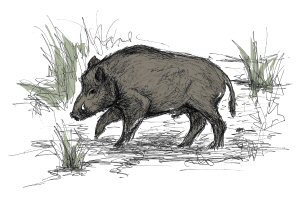
The Pig. The Gentleman Who Pays the Rent.


The Pig. The Gentleman Who Pays the Rent.

The pig was always highly prized for its tasty meat and in Irish legend it was the favourite meat of the Gods and heroes at their feasts in the otherworld. It was also greatly respected for its bravery and fierce spirit when defending itself and for this reason was one of the symbols of the warrior.

In Irish Folklore the pig is seen as a lucky animal and they were also able to see the wind and forecast the weather, they were also said to have magical hearing and they could actually hear the grass growing.

Evil or threatening spirits were often said to appear in the form of a black pig and it was believed that this was the worst of all forms for fairy folk to take so people would carry a hazel stick to ward of the evil spirits. This time of year (Halloween/Samhain) when the barriers between this world and the next are weakest is a favourite time for the Black Pig to be abroad so you would be wise not to travel alone at this time.

The pig occurs in Irish folk cures. A cure for a child with mumps was to take it to a pigsty and rub it's head on the pigs back in the hope that the illness would transfer into the pig. It was also believed that a cure for a toothache was for the sufferer to put their head to the ground where a pig had been scratching its backside while making the sign of the cross with their mouth. If you did this you would never suffer from toothache again. Another disgusting cure for jaundice involved swallowing a dozen live lice from a pig.

The Gentleman Who Pays the Rent.

This is the euphemism that was once used in Ireland to describe what was often a family's most valuable possession - the pig.

Until the advent of the industrial age, most people lived a relatively agricultural life. In Ireland before the potato famine, cottagers who may not have been able to afford a riding horse or beef cattle would at the very least keep a few pigs. They were usually housed close to the main dwelling, and sometimes the pig house was attached to one end of the cottage.

Now you might be surprised to see this sort of housing arrangement but the pig was a very valuable part of the Irish cottage economy and pigs do best in warm, dry surroundings. So not only did this practice help keep the pigs (and often a milk cow and laying hens) warm and safe from predators, it was easier feeding kitchen scraps to the pig and hens and collecting manure which was both valuable and very necessary for growing healthy crops. Manure was in fact so valuable you stacked it outside the front of the cottage so you could keep your eye on it.

Pigs were butchered in the autumn , around Samhain. This meant that the animals wouldn’t need scarce fodder over the winter (stocking up enough hay was tedious and land-intensive for a small-holder). It also meant that the cooler weather would slow down spoilage until the salted meat could cure. Cottagers would preserve enough ham, bacon, sausage & lard to see them through the year, and sell the rest to the butcher. However, in poorer households, people did not eat their pig. They sold it to get money to pay the rent on their land. That is why the family's pig was often called "the gentleman who pays the rent."

“The “pig in the parlour” stereotype of Ireland came from the system landlords imposed more than three centuries ago of charging people extra rent for pig houses. The poor country people found that as a pig is a clean and intelligent animal, it could share a clay cabin without soiling it if allowed to come and go. Until recent times there was a tradition in rural Ireland of keeping one pig in the yard to eat the scraps and provide an extra source of food. The practice came to be associated with poverty and died out with the coming of supermarkets.”

Wednesday, October 20, 2010

The Hurley. Also known as the Camán.


The Hurley. Also known as the Camán

The earliest recoded reference of the game of hurley being played by the anciemt tribes of Ireland dates from 1800 BC to 1300 BC. First recorded in the ancient Irish Annals.

The Irish Annals are a body of work mixing Irish history with legend and mythology. The annals record in 1272 BC, that the strongest and most skilled warriors of the Tuatha de Danann defeated their rivals, the Firbolgs, in a hurley match to the death at The First Battle of Moytura. There were twenty-seven men on each side and when the game was over, the casualties were afforded a funeral of honour and were buried together under a huge stack of rocks known as a cairn, an ancient equivalent of our modern day monuments and burial headstones.

At the Second Battle of Moytura, the Tuatha de Danann leader, Nuada, would be killed by the Formorians, another of the original inhabitants of Ireland. Celtic Sun God Lugh, one of the Danann warriors, would emerge as a hero having killed the Formorian warrior, Balor, by shooting a stone into the giant’s eye.

Later, the Brehon Laws would declare the game of Hurley as a form of Irish military service. The laws asserted, if a man was killed or injured by a Hurley, either his surviving family or himself are eligible for life-long financial assistance. This could be considered the earliest example of a military disability or widow’s pension. Also stipulated in the laws, all sons of kings and chieftains were to be supplied with Hurley sticks during the traditional period of fosterage with another noble family.

In 200 BC The Irish Annals recorded the childhood exploits of King Lowry Loingseach. Lowry, said to be mute, only uttered his first words after being hit with a stick during a Hurley match. It is not known what he said but it is believed to be unrepeatable.

Around 100 BC, Cuchulain, an Ulster warrior, leader of The Red Branch Warriors and son of the Celtic Sun God Lugh and a human mother Dechtire, gained youthful fame on account of his hurling abilities. In one legendary incident, he single-handedly defeated one hundred and
Fifty warriors in a hurling match on the Field of Armagh.

Angered by their defeat, the men attacked Cuchulain, but he fought back killing fifty men with his bare hands before the others fled the field. Considered the greatest warrior of ancient Ulster, Cuchulain was known for his uncontrollable temper and physical deformities, such as having seven fingers on each hand and seven toes on each foot. He was said to go insane with uncontrollable rage and, during times of insanity, was reported as having seven pupils in each eye. On one occasion, he had reportedly carried the ball on the blade of his Hurley stick a distance of nine miles in a repetitious motion of throwing the ball into the air and catching it on his blade before it could drop to the ground.

Cuchulain was the nephew of King Conchobar. At the age of seventeen, Cuchulain singularly defeated the forces of Maeve, warrior Queen of Connacht, when she tried and failed, in an attempt to capture Ulster. Tales of all kinds are told about him. At the age of twenty-seven Cuchulain, finally met his match when he was killed in an ambush. His attackers are said to have severed his head using the great warrior’s own hurley stick.

Hurley continued to be popular in Ireland but, according to the Irish texts, The Dun Cow 1100 AD, and The Book of Leinster 1160 AD, it was not until the 3rd century AD that the Irish had their next great Hurley warrior. Fionn MacCumhail, popularly known as Finn MacCool, was the mythical leader of the fighting band Fianna Eireann. MacCool is said to be a descendant of the god Nuada, former king of the Tuatha De Danaan. MacCumhail's most notable hurley accomplishment occurred when he defeated fifty men by scoring the decisive goal in a match at Tara. His reward for his deed was a kiss from King Cormac MacArt’s daughter - the woman he was to subsequently marry.

Even in the religious records of ancient Ireland one finds mention of hurley. Such is the example and story of the visit of Saint Colmcille to Tara. In the 5th Century Tara was reputed to have been a powerful and sacred place of gods and an entrance to the other world. During his time there, a Connacht prince used a hurley to kill a young boy. Although Saint Colmcille attempted to intervene, the prince was summarily executed on the spot, for such was the anger of those who had witnessed this savage act.

Hurling eventually evolved into a sport and was played by teams representing neighbouring villages. The teams could be made up of all the available males capable of holding a stick and might have lasted several hours. They were usually for the honour of the village, to settle disputes or for entertainment value.

It has been held in high esteem throughout the ages and has become one of our national games supported by huge armies of fans flying their county colours and promoted all over the world by The Gaelic Athletic Association.

It has to be one of the fastest team sports played today, exciting and a little dangerous it is the embodiment of the Irish spirit. The game of Camogie played by women is almost identical to the game of hurling and is both as exciting and as popular. If you get the chance to watch a game or better still go to a game and join in the crowd excitement then don’t hesitate.