Showing posts with label Celtic fesivals.. Show all posts
Tuesday, August 2, 2011
Lughnasadh.
Lughnasadh.
Lughnasadh is the beginning of the harvest season, also known as The harvest of the first fruits’ (Anglo-Saxon), and the time of the funeral games of the Celtic goddess Tailtiu. Tailtiu died clearing a forest so that the land could be cultivated. As she lay on her death bed she spoke to those that had gathered around her. She asked that funeral games be instituted in her honour and that her foster son Lugh should lead the games.
Tailtiu prophesied that as long as the games were held Ireland would be known for its song. Tailtiu gave her name to Teltown, County Meath, and it was there that the festival of Lughnasadh was traditionally held, eventually evolving into a huge tribal gathering. It was here that the High King presided over legal agreements, disputes and political problems of the day. It was also here that athletes competed against each other, artists and entertainers showed off their talents and traders gathered to sell their wares. Another important ritual that was to take place was that of ‘Handfasting’ where couples would be joined together for a year and a day, if all went well then it would become a permanent arrangement and if not they would return the following year to separate.
Throughout the centuries we have celebrated the harvest and we still continue to do so. Lughnasadh has been given additional names over the years, here in our corner of County Mayo it is also known as Reek Sunday or Garland Sunday and people climb our local mountain Croagh Patrick (known locally as the ‘Reek’). In some areas it is known as ‘Bilberry Sunday’ again celebrations include climbing a local hill or mountain. Some will call it Lammas (Anglo-Saxon).
In some parts of Ireland the nearest Sunday to Lughnasadh was known as Cally Sunday. It was the traditional day to lift the first new potatoes. The man of the house would dig the first stalk while the woman of the house would wear a new white apron and cook them, covering the kitchen floor with green rushes in their honour. The family would give thanks that the 'Hungry Month' of July was over and the harvest had begun. Though initially the custom of first fruits usually applied to grain, in later days, when grain crops were the province of large landowners, common people had no grain of their own to offer. The first fruits custom was then transferred to potatoes, an offering available to everyone with a patch of ground, and widely grown as a subsistence crop. Cally is a mixture of potato mashed together with butter, milk and sliced onion.
Lughnasadh was also a time when people would visit sacred/holy wells and leave offerings and by visiting the hilltops and the wells you were celebrating both the summit and the depths of the earth. Another name that is used for Lughnasadh gatherings is ‘Wake Fairs’, in Ireland a wake is the time spent keeping the body of someone that has died company until it has been buried. It is a time to celebrate the person’s life and we have food, drink and tobacco. We tell stories of their life and some may be very funny. One way we celebrate Lughnasadh is by having a wake for the corn god and we place a symbol of the corn god in the field after harvest. The offering/symbol is usually in the shape of a corn dolly. Before Christianity took hold in Ireland (and even afterwards) within the traditional pagan agricultural culture it was believed that the spirit of the corn lived amongst the crop, and that when the crop was harvested it was made effectively homeless. The people believed a spirit lived in the field and as they cut the harvest the spirit retreated before them. The last bunch of corn was kept and given to the oldest man to plait and keep it on the wall until the following year's crop was sewn when the spirit would be returned to the field by being shaken from last year’s corn bunch.
Corn Dolly making is an ancient craft going back thousands of years, when as previously stated, it was thought that a spirit lived in the cornfields. To preserve this spirit at harvest time, and ensure the success of next year's harvest, a corn dolly was made for it to rest in. Ivy was a symbol of rebirth, and so it wasn't uncommon to dress the corn doll with a headdress of ivy. The Corn Dolly was originally made to appease the corn spirit with the hope of a good harvest the following year. Traces of corn dolly shapes have been found dating back to 2000 B.C. and it has always been the tradition to plough the previous year’s dolly back into the field the following year.
We will celebrate Lughnasadh by holding our ritual followed by feasting on the foods of the harvest and a few drinks. We will have music, song and maybe a story or two. However you choose to celebrate your Lughnasadh, may your harvest be a fruitful one, may the sun shine for you and may you reap the rewards you deserve for all your hard work.
Keep smiling and blessings of Lugh to you all.
Saturday, October 30, 2010
Samhain: 31st-October or 7th-November.


Samhain: 31st - October or 7th - November.
Ritual and Tradition in the Turning Wheel
As the wheel of the Year turns and the days of Autumn are upon us, the feast of the Pagan Calander, Samhain or New Year’s draws ever closer. Once the apex of social events - the great feast that would warm in memory throughout the bitter winter, the last chance to see the family, including one’s ancestors, before the dark days fell upon the land – this solemn and spiritual event has become perhaps the trashiest modern festival around. The pollution and corruption of this feast by both Christianity and Commercialism is breathtaking in its scope.
Whereas other pagan feasts were adopted and adapted, Oestara becoming Easter, Yule evolving into Christmas, “Halloween” not only hi-jacks the deepest held beliefs and practices of our Pagan ancestors, but manages to insult the very culture it has purloined. Not content with parodying elements of ancient ritual such as the Dead Feast, or divination, (monkey nuts and throwing an apple-peel over one’s shoulder in modern parlance), mainstream churches have ensured many people think the origins of Halloween lie in a form of devil worship. A little annoying for a culture that didn’t believe in a Devil, but certainly telling us more about Christianity and other orthodoxies than about our pagan past!
Samhain: Now is the time of summer’s end the harvest is in, the livestock have been brought down to the lower pastures and if the gods/goddesses have been kind to you then your larder is full. It is also the feast of the Dead in the Celtic Calendar. On this night the veils between the worlds are lowered and not only can a dedicated person seek advice from the Other-worlds but the dead ancestors can reach out to the living.
There is more than one Otherworld. There is what other cultures might call the Faerie World, the magical lands of the Tuath de Danaan who became known as the people of the Sidhe, they who live in the Hollow Hills. There is the Otherworld proper, where we go when we die. Part of our spirit remains there, a trace of us, while the more integrated self is reborn. When we pray to the ancestors we access the sum of all the wisdom learned by all the people through all the long years. There is the Homeland where dwell the Gods and Goddesses: where we can access the Archetypes (such as the Warrior, or the Chief or the Bard.) All these worlds are open to you at Samhain, provided you seek them with a gentle heart and with a respectful purpose.
People generally celebrate Samhain on the 31st of October and this means that you can have a big party to celebrate it and invite all your “normal” friends! For once you probably won’t be the strangest person there. There is also the tradition that has become widely known as Old Samhain: this is celebrated mainly on the 8th of November, although (rarely) it is also celebrated on the 7th here. This is closer to the original date of Samhain in the pre-Gregorian calendar, and almost all Traditional druids and witches in Celtic areas mark this day in some way or another.
Samhain marks several things. As with all Celtic pagan feasts it marks a point on the wheel of the year, in this case the end of the year, and beginning of the New Year. This date, obviously, was a great occasion in Celtic society. Samhain was the period of the year when the livestock which would not make it through the winter was marked out and slaughtered, to be feasted on and to be dried out as provision for the long dark months ahead. This, coupled with the sense of the world going underground for the winter, led to this feast being a feast uniquely concerned with death and the spirit world. At this time, the veils between the world of living and dead were felt to be very flimsy and our ancestors instinctively realized that the spirits, and ancestors, were close at hand.
Because Celtic culture was not secular in the sense that modern society is secular, they had no problem mingling the mundane and profane with the sacred and spiritual: it is difficult to imagine today a world so unselfconscious about its philosophy of life and death, so natural in its approach, that alongside the great feasts of New Year, were held the ritual feasts of the Dead. This dumb feast or dead feast is a very important part of celebrating Samhain: it is part invitation to the universe and to the Ancestors to commune and advise, part soul journey, part act of remembrance and part act of acceptance.
The Celtic belief in an otherworld was very complex and very strong. As you died in this world you were reborn in that world. Death here was celebrated for the birth in the Otherworld and birth here was marked with mourning for the death in the Otherworld. There was a constant exchange of souls between the two. With such a belief you can see how a celebration of death at the moment of the New Year is very appropriate and how there was not the fear and morbidity associated with death that has become so much a part of modern life and which as much as anything contributes to the misunderstanding and misinterpretation by the Christian community of the sacred rite of death in pagan life, known as Samhain and subsequently as Halloween.
We shall light a candle that we will place in our window to guide our ancestors home. There will be a spare place set at the table and we shall read the cards to see what the New Year may bring. We will of course celebrate Halloween for the craic (we are after all Irish). We will enjoy the night for what it is but we will have our ritual on the 7th-November. Whichever you choose or like us both if you wish I would like to say:
Blessings of Samhain to one and all. Beannachtaí na Samhna ar gach duine.
Thursday, September 30, 2010
The Fesival of Samhain.


As we enter this month of October let us begin by looking at the festival of Samhain.
History of Samhain
Samhain marks one of the two great doorways of the Celtic year, for the Celts divided the year into two seasons: the light and the dark, at Beltane on May 1st and Samhain on November 1st. Some believe that Samhain was the more important festival, marking the beginning of a whole new cycle, just as the Celtic day began at night. For it was understood that in dark silence comes whisperings of new beginnings, the stirring of the seed below the ground. Whereas Beltane welcomes in the summer with joyous celebrations at dawn, the most magically potent time of this festival is November Eve, the night of October 31st, known today of course, as Halloween.
Samhain (Scots Gaelic: Samhuinn) literally means “summer's end.” In Scotland and Ireland, Halloween is known as Oíche Shamhna, while in Wales it is Nos Calan Gaeaf, the eve of the winter's calend, or first. With the rise of Christianity, Samhain was changed to Hallowmas, or All Saints' Day, to commemorate the souls of the blessed dead who had been canonized that year, so the night before became popularly known as Halloween, All Hallows Eve, or Hollantide. November 2nd became All Souls Day, when prayers were to be offered to the souls of all who the departed and those who were waiting in Purgatory for entry into Heaven. Throughout the centuries, pagan and Christian beliefs intertwined in celebrations from Oct 31st through November 5th, all of which appear both to challenge the ascendancy of the dark and to revel in its mystery.
In the country year, Samhain marked the first day of winter, when the herders led the cattle and sheep down from their summer hillside pastures to the shelter of stable and byre. The hay that would feed them during the winter must be stored in sturdy thatched ricks, tied down securely against storms. Those destined for the table were slaughtered, after being ritually devoted to the gods in pagan times. All the harvest must be gathered in -- barley, oats, wheat, turnips, and apples -- for come November, the faeries would blast every growing plant with their breath, blighting any nuts and berries remaining on the hedgerows. Peat and wood for winter fires were stacked high by the hearth. It was a joyous time of family reunion, when all members of the household worked together baking, salting meat, and making preserves for the winter feasts to come. The endless horizons of summer gave way to a warm, dim and often smoky room; the symphony of summer sounds was replaced by a counterpoint of voices, young and old, human and animal.
In early Ireland, people gathered at the ritual centres of the tribes, for Samhain was the principal calendar feast of the year. The greatest assembly was the 'Feast of Tara,' focusing on the royal seat of the High King as the heart of the sacred land, the point of conception for the New Year. In every household throughout the country, hearth-fires were extinguished. All waited for the Druids to light the new fire of the year, not at Tara, but at Tlachtga, a hill twelve miles to the north-west. It marked the burial-place of Tlachtga, daughter of the great druid Mogh Ruith, who may once have been a goddess in her own right in a former age.
At all the turning points of the Celtic year, the gods drew near to Earth at Samhain, so many sacrifices and gifts were offered up in thanksgiving for the harvest. Personal prayers in the form of objects symbolizing the wishes of supplicants or ailments to be healed were cast into the fire, and at the end of the ceremonies, brands were lit from the great fire of Tara to re-kindle all the home fires of the tribe, as at Beltane. As they received the flame that marked this time of beginnings, people surely felt a sense of the kindling of new dreams, projects and hopes for the year to come. Rituals of Samhain mirror many Halloween practices today.
Many Samhain rituals, traditions, and customs have been passed down throughout the centuries, and are still practiced in various countries on Halloween today.
As a feast of divination, this was the night for peering into the future. There are so many types of divination that are traditional to Halloween it is possible to mention only a few. Girls were told to place hazelnuts along the front of the fire grate, each one to symbolize one of her suitors. She could then divine her future husband by chanting, “If you love me, pop and fly; if you hate me, burn and die.”
Several methods used the apple, that most popular of Halloween fruits. You should slice an apple through the equator (to reveal the five-pointed star within) and then eat it by candlelight before a mirror. Your future spouse will then appear over your shoulder. Or, peel an apple, making sure the peeling comes off in one long strand, reciting, “I pare this apple round and round again, My sweetheart’s name to flourish on the plain, I fling the unbroken paring o’er my head, My sweetheart’s letter on the ground to read.” Or, you might set a snail to crawl through the ashes of your hearth. The considerate little creature will then spell out the initial letter as it moves.
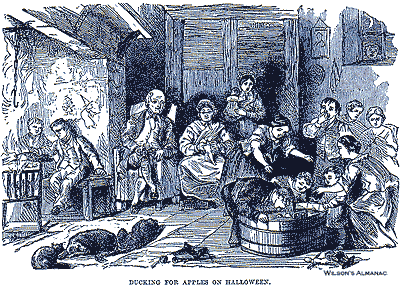
Bobbing for apples was actually a custom the Celts inherited from the Romans when conquered by the Roman Empire. Romans honoured the harvest god, Pomona, and because the apple was a venerated fruit, many rituals revolved around it. The Celts simply incorporated bobbing for apples, a divination game that originated with the Romans, into Samhain tradition.
Or
Bobbing for apples may well represent the remnants of a Pagan “baptism” rite called a seining, according to some writers. The water-filled tub is a latter-day Cauldron of Regeneration, into which the novice’s head is immersed. The fact that the participant in this folk game was usually blindfolded with hands tied behind the back also puts one in mind of a traditional Craft initiation ceremony.
Or
Bobbing for apples was a game of divination. Single girls looking for a mate would carve their initials onto an apple then put it into a bucket of water. Young men would take it in turns to ‘bob’ for an apple, the one they chose had the initials of their intended carved upon it.
Carving Jack O'Lanterns was a custom practiced by Irish children during Samhain. Using a potato or turnip, they would carve out an image and place a candle inside to pay tribute to Jack, an Irish villain so amoral that he was rejected by both god and devil. Legend says that Jack wandered the world, looking for a place to rest, finding it only in a carved-out vegetable. Later, when the Irish emigrated to America, pumpkins were used instead.
Some traditions say that the carved-out pumpkin originated from a Celtic practice of putting an antecedent's skull outside of their home during Samhain. Others say that the Jack O'Lantern was used to ward off evil spirits which were brought forth on All Hallows Eve.
Halloween masks and costumes originated from the Celtic belief that on Samhain, while restless and often evil spirits crossed the thin void from the spirit world, a mask would make the wearer unrecognizable from these ghosts. Druidic rites also involved the wearing of masks, often made of animal’s skins, as the wearers told fortunes and practiced other divination rituals.
Christian Influence over Samhain.
As Christianity spread throughout the Celtic regions, an attempt was made to remove the pagan influences of this holiday and replace them instead with a Christian-sanctioned one. To this end, Pope Boniface IV renamed Samhain, which fell on November 1, to All Saints Day, as a day to honour dead saints. October 31 began to be called All Hallows Eve; this eventually evolved into "Halloween."
Attributed to St. Odilo in the 7th century, the Catholic Church declared November 2 as All Soul's Day, which honours the dead whom had failed to make it to heaven; it's believed these souls were instead held in purgatory. This Christian celebration of the day of the dead has many similarities to Samhain rituals, such as the wearing of masks, parades of ghosts and skeletons, and special food offerings to the dead.
The Samhain fires continued to blaze down the centuries. Even today, bonfires light up the skies in many parts of Ireland. Whatever the reason, there will probably always be a human need to make fires against the winter’s dark.
Saturday, September 18, 2010
The Autumn Equinox.


Autumn Equinox:
The Autumnal Equinox signals the end of the summer months and the beginning of winter. At this time of year, days have been shortening since the Summer Solstice some three months earlier, and the Equinox is the point where nights reach the same length as days. After this point, the Sun will shine lower and lower on the horizon until the Winter Solstice in about three months' time.
The Autumn Equinox is a time of harvesting and preparation. It is a time to reflect on your life and to start making plans for the future. The main agricultural harvest has been gathered and all that is left are the late fruits, berries and nuts.
As plants wither, their energy goes into the hidden roots and nourishes the Earth. The leaves of trees turn from green to red, brown and gold - symbolic of the sinking Sun as nature prepared for winter. This is the time of balance between the outer and the inner worlds. From now on, we should turn towards nurturing our own roots, pondering our inner lives and planning for the long-term. Thoughts can be seeded, gradually growing in the unconscious until they can emerge in the spring. It is the drawing in of family as we prepare for the winding down of the year at Samhain. It is a time to finish old business as we ready for a period of rest, relaxation, and reflection.
A time of celebration for the bounty of the earth and a time of balance reflecting on the equal length of both day and night. Hospitality is another tradition common for this time of the year as in times past you never knew when your neighbour might have to provide food for your family if your own supplies ran low during the winter months. Weak and old animals and livestock were often slaughtered at this time of year to preserve winter feed stocks.
A lovely place to visit at the time of the Equinox is Loughcrew and here is a short description. If you get the chance go and check it out, you won’t regret it.
Loughcrew (Irish: Loch Craobh) is near Oldcastle, County Meath, Ireland. (Sometimes written Lough Crew). Loughcrew is a site of considerable historical importance in Ireland. It is the site of megalithic burial grounds dating back to approximately 3500 and 3300 BC, situated near the summit of Sliabh Na Caillí. Lough Crew Passage Tomb Cemetery is one of the big four passage tomb sites in Ireland (the others are Bru Na Boinne, Carrowkeel and Carrowmore).
The sites consist of cruciform chambers covered in most instances by a mound. A unique style of megalithic petroglyphs are seen there, including lozenge shapes, leaf shapes as well as circles. The site has three parts; two are on hilltops, Carnbane East and Carnbane West. The other, less well preserved cairn is at Patrickstown. The Irish name for the site is Sliabh Na Caílli, which means mountains of the witch, and legend has it that the monuments were created when a witch flying overhead dropped her cargo of large stones from her apron.
The orthostats and structural stones of the monuments tend to be from local green gritstone, which was soft enough to carve, but which is also vulnerable to vandalism. There is a widespread belief that Cairn T in Carnbane East is directed to receive the beams of the sun at sunrise on the autumn Equinox - with light entering and illuminating the art on the backstone.
Autumn Equinox.
Most people want to be the sun that brightens up your day
But I’d rather be the moon that shines down on you in your darkest hour
For as the days shorten and harvest drifts away
The fire draws us in and warms us with its power
It is time to reflect upon the past and to look deep within your soul
Are you content with what you have achieved this year?
Have you worked towards your chosen goal, or goals?
Have you shared laughter, have you shared tears?
It’s the Autumn Equinox, equal day, and equal night,
And the sunset’s a glorious pink
The moon battling the sun, begins to win the fight
It’s getting colder now, as into the west it sinks.
The earth is growing tired and prepares to go to sleep
And winter will rule now the battle is done
But the seed that lies dormant, buried deep
Awaits the spring and the warmth of the rising sun.
© Antoine O’Lochlainn 2008 (Ciúnas).
Sunday, August 8, 2010
Lughnasadh August 7th 2010.
Location = Lungna's Well
A group of us from The Family of Rowan celebrated Lughnasadh this year at Lugna's well in County Offaly. A monastery was founded here by St. Lugna in the sixth century, situated at the junction between two ancient roads, the Slighe Mór and the Slighe Dála which were two of the great roads in medieval Ireland.
The placename Leitir Lugna means the ‘ wet hillside of Lugna’ which aptly describes the setting for this monastery. The feast day of St Lugna was on April 27th.
All that survives today are the remains of a medieval parish church, the recently restored St. Lugna’s holy well and the outline of the monastic enclosure in the fields to the north and east of the church.
An Early Christian cross-inscribed slab, a medieval human head and an ox head all of which came from Letter church can now be seen in the west gable of the Catholic church in Cadamstown village.
The remains of a barrel vaulted priests chamber are all that survives of Letter church. This was the residence of Conchobhar Ó hÓgáin who in 1473 was accused of both neglecting and selling ‘the precious moveable goods’ of the church and was also accused of keeping a concubine in the ‘priests house’ with whom he later fathered a son. Nice to think there is a bit if consistency within the church to this very day.
T|he Well is still used by people who consider it to hold the cure for warts and other ailments. There is a lovely feeling of peace here. We opened a circle and performed our ritual which included an element of fun as this is the time of 'The Games of Lugh'.
We finished by thanking the spirits of the place and closing the circle. The celebrations carried on with our traditional feast and a good time was had by all in attendance.
Although some members were absent for a variety of reasons we remembered all in our thoughts and look forward to the Autumn Equinox.
Tuesday, July 20, 2010
Lughnasa.


Lughnasa.
The Reek.
Long before St Patrick’s visit in 441, the Reek was known by its ancient name of Cruachán Aigli. Cruach’ in English is a variant of ‘rick’ or reek, or stacked-up hill and refers to the cone-shaped mountain. Some translators took ‘Aigli’ to mean ‘Eagle’.
On foot of this interpretation, the coat of arms for Westport town incorporates an eagle and, in the nineteenth century, part of the ridge extending eastwards from the peak or Reek was still called Mount Eagle.
The name Cruach Phádraig started to gain prominence over Cruachán Aigli from the tenth to the thirteenth century. In the sixteenth century when many Irish place names were given an Anglicised version, Cruach Phádraig became widely known as Croagh Patrick.
Pagans celebrate the harvest with the festival of Lughnasa, held in honour of the god Lugh and whose name is now encompassed in the Irish for August (Lughnasa). (Nasa means games or an assembly). This festival took place throughout the country, often in high places such as The Reek.
Locally the festival became known as Domhnach Chrom Dubh (Black Crom Sunday. Crom Dubh features in legend as a pagan god.), Garland Sunday, the last Sunday of Summer, Domhnach na Cruaiche (Reek Sunday).
The Boheh Stone
In 1987 Gerry Bracken (a local historian) discovered that while standing at the Rock of Boheh which is about 7km (just over 4m) from Croagh Patrick, that the setting sun, rather than disappearing behind Croagh Patrick, actually rolls down the north slope of the mountain. This phenomenon lasts about twenty minutes and occurs on the 18 April and 24 August each year. These two dates, with 21 December, split the year into three equal parts and it is thought that they were used to celebrate sowing and harvesting seasons.
The spectacle of the rolling sun in prehistoric times probably merited the inscription on the Boheh rock outcrop, depicting many cup-and-ring marks, making it one of the finest examples of Neolithic rock art in Ireland and Britain
Winter Solstice
Less than a kilometre from Croagh Patrick is the ancient ritual site of Annagh, Killadangan, which has a standing stone row at its centre. This stone row aligns with the setting sun at 1.40pm on 21 December each year. The sun sets into a notch on the east-ridge of Croagh Patrick. On the same day as the rising sun is celebrated at Newgrange, the setting sun retires to its sacred celestial home at Croagh Patrick.
Before 1113 AD Lent or St Patrick’s Day (March 17th ) was the accepted time of year to make a pilgrimage to Croagh Patrick, but in this year a thunderbolt is said to have killed thirty of the pilgrims and the pilgrimage period was changed to summer, the most popular dates being the last Friday or Sunday of July. This story can be seen as an example of the old pagan gods gaining revenge on their Christian usurpers.
Although Croagh Patrick was originally a pagan sanctuary for the celebration of life’s abundance, under Christianity it became the scene of penance for supposed sinfulness. Many of the Christian pilgrims ascended the mountain barefoot, or even on their knees, as an act of atonement. The positive aspects of the original Celtic Lughnasa celebrations have been warped by the Catholic Church, imposing negative and alien concepts of control, fear, and guilt.
Tuesday, June 22, 2010
Mid-Summer Solstice.


Midsummer Solstice has now passed and we held a small ritual in our circle at home. Ms Owl is now feeling a lot better (stomach upset) and all is well in our world. Our grandson celebrated his fourth birthday, he was born on the 21st-June so a double celebration.
On sunday we went on a day out to Clare and visited Cragganowen - the living past, a depiction of an Iron Age settlement where we saw a Crannog, a selection of Round Houses and a fulacht fiadh (phrase translates as "a pit of the deer" or "the pit of the Fianna," a mythological band of Celtic warriors famed for their heroic feats).
Usually located close to rivers or boggy areas, the pits resemble low, horseshoe-shaped, grassy mounds with a depression at the centre. The hollow area in the middle indicates the location of a wood, clay, or stone-lined pit. The mounds consist of fire-cracked stones that were taken from the pit and scattered around the pit, but with an access path left open. Over time, the stone deposits formed the distinctive pit shape. Radiocarbon dating indicates that the pits were built during the Bronze Age, 4,500 years ago, when we Irish were busy farming cereal crops and rearing cattle.
While the true purpose of the fulacht fiadh remains a mystery, most archaeologists agree that they were used to heat water. This was done by putting fist-size stones on an open fire and then transferring these hot stones into a water-filled trough. This method is actually a very effective way to heat large volumes of water.
We also visited Knappogue Castle I found some of the symbols over the doorways to be of interest. Over one we saw the compass and square of the Freemasons and over another a pentagram.
Subscribe to:
Comments (Atom)