Saturday, October 30, 2010

Samhain: 31st-October or 7th-November.


Samhain: 31st - October or 7th - November.

Ritual and Tradition in the Turning Wheel

As the wheel of the Year turns and the days of Autumn are upon us, the feast of the Pagan Calander, Samhain or New Year’s draws ever closer. Once the apex of social events - the great feast that would warm in memory throughout the bitter winter, the last chance to see the family, including one’s ancestors, before the dark days fell upon the land – this solemn and spiritual event has become perhaps the trashiest modern festival around. The pollution and corruption of this feast by both Christianity and Commercialism is breathtaking in its scope.

Whereas other pagan feasts were adopted and adapted, Oestara becoming Easter, Yule evolving into Christmas, “Halloween” not only hi-jacks the deepest held beliefs and practices of our Pagan ancestors, but manages to insult the very culture it has purloined. Not content with parodying elements of ancient ritual such as the Dead Feast, or divination, (monkey nuts and throwing an apple-peel over one’s shoulder in modern parlance), mainstream churches have ensured many people think the origins of Halloween lie in a form of devil worship. A little annoying for a culture that didn’t believe in a Devil, but certainly telling us more about Christianity and other orthodoxies than about our pagan past!

Samhain: Now is the time of summer’s end the harvest is in, the livestock have been brought down to the lower pastures and if the gods/goddesses have been kind to you then your larder is full. It is also the feast of the Dead in the Celtic Calendar. On this night the veils between the worlds are lowered and not only can a dedicated person seek advice from the Other-worlds but the dead ancestors can reach out to the living.

There is more than one Otherworld. There is what other cultures might call the Faerie World, the magical lands of the Tuath de Danaan who became known as the people of the Sidhe, they who live in the Hollow Hills. There is the Otherworld proper, where we go when we die. Part of our spirit remains there, a trace of us, while the more integrated self is reborn. When we pray to the ancestors we access the sum of all the wisdom learned by all the people through all the long years. There is the Homeland where dwell the Gods and Goddesses: where we can access the Archetypes (such as the Warrior, or the Chief or the Bard.) All these worlds are open to you at Samhain, provided you seek them with a gentle heart and with a respectful purpose.

People generally celebrate Samhain on the 31st of October and this means that you can have a big party to celebrate it and invite all your “normal” friends! For once you probably won’t be the strangest person there. There is also the tradition that has become widely known as Old Samhain: this is celebrated mainly on the 8th of November, although (rarely) it is also celebrated on the 7th here. This is closer to the original date of Samhain in the pre-Gregorian calendar, and almost all Traditional druids and witches in Celtic areas mark this day in some way or another.

Samhain marks several things. As with all Celtic pagan feasts it marks a point on the wheel of the year, in this case the end of the year, and beginning of the New Year. This date, obviously, was a great occasion in Celtic society. Samhain was the period of the year when the livestock which would not make it through the winter was marked out and slaughtered, to be feasted on and to be dried out as provision for the long dark months ahead. This, coupled with the sense of the world going underground for the winter, led to this feast being a feast uniquely concerned with death and the spirit world. At this time, the veils between the world of living and dead were felt to be very flimsy and our ancestors instinctively realized that the spirits, and ancestors, were close at hand.

Because Celtic culture was not secular in the sense that modern society is secular, they had no problem mingling the mundane and profane with the sacred and spiritual: it is difficult to imagine today a world so unselfconscious about its philosophy of life and death, so natural in its approach, that alongside the great feasts of New Year, were held the ritual feasts of the Dead. This dumb feast or dead feast is a very important part of celebrating Samhain: it is part invitation to the universe and to the Ancestors to commune and advise, part soul journey, part act of remembrance and part act of acceptance.

The Celtic belief in an otherworld was very complex and very strong. As you died in this world you were reborn in that world. Death here was celebrated for the birth in the Otherworld and birth here was marked with mourning for the death in the Otherworld. There was a constant exchange of souls between the two. With such a belief you can see how a celebration of death at the moment of the New Year is very appropriate and how there was not the fear and morbidity associated with death that has become so much a part of modern life and which as much as anything contributes to the misunderstanding and misinterpretation by the Christian community of the sacred rite of death in pagan life, known as Samhain and subsequently as Halloween.

We shall light a candle that we will place in our window to guide our ancestors home. There will be a spare place set at the table and we shall read the cards to see what the New Year may bring. We will of course celebrate Halloween for the craic (we are after all Irish). We will enjoy the night for what it is but we will have our ritual on the 7th-November. Whichever you choose or like us both if you wish I would like to say:

Blessings of Samhain to one and all. Beannachtaí na Samhna ar gach duine.

Wednesday, October 27, 2010

Soul Gatherers.


Soul gatherers.

Many birds were believed to carry dead souls or were dead people incarnate. The belief in transmigration of human souls goes back to ancient times. Often these bird souls would come back with a message or warning.

The Storm Petral also known as ‘Mother Carey’s Chickens’ contained the souls of dead seamen who came to warn their brethren of approaching storms. Seagulls were regarded as the repositories of dead souls and were not to be harmed.

Back on land, when Sedge Warblers sang at night and particularly at midnight, their voices were believed to be those of dead babies who chose to return temporarily from the otherworld to sing, to soothe the hearts and minds of their poor grieving mothers.

Magpies were regarded as the repositories of the souls of evil minded or gossiping women.

Swans contained the souls of virtuous women and they had the capability of turning back into human form.

The Linnet was thought to contain an unhappy soul that was trapped in the other world.

The Seven Whistlers.

These were said to be seven birds, flying together by night, whose cries forebode disaster. Belief in them was fairly common among seamen this being a risky occupation where whistling was thought to be unlucky. Sometimes the Whistlers were said to be the spirits of the dead, especially those who had themselves been fishermen, returning to warn comrades of danger; when they were heard, one must at once stop work and return home, otherwise lives would be lost. Even those who knew the cries were in fact those of curlews and similar birds still dreaded the sound, and would not go out until the next day.

They were variations to this tale, they were said to be seven ghostly birds that presage death and disaster flying alongside the Bean sidhe.

Another variation suggested that the birds carry the grief stricken souls of unbaptised babies condemned to roam the skies forever (another one of those Christian stories).

Also known as the Sluagh. They were seen to fly in groups like flocks of birds, coming from the west, and were known to try to enter the house of a dying person in an effort to carry the soul away with them. West-facing windows were sometimes kept closed to keep them out. Some consider the Sluagh to also carry with them the souls of innocent people who were kidnapped by these destructive spirits.

The Lough Gur Hunt-Limerick.

This is a group of hounds that fly across the sky at night barking and howling. They presage death in the house of anyone who hears them. It’s possible that this story came about because the Barnacle/Canadian Geese flying overhead at night can make a sort of barking noise.

There are variations to this story across Europe, for example in England it is known as Gabriel’s Hounds. This is a spectral pack of hounds which travel across the sky at night led by a ghostly hunter. They are searching for the souls of people on their death beds.

Tuesday, October 26, 2010

Whistling Dobhar chú of Lough Glenade.


Whistling Dobhar chú of Lough Glenade.

As Halloween/Samhain approaches I will tell you one more tale, before the pooka begins to roam.

I have made mention of the Dobhar chú in a previous post but only a passing reference to Grace Connolly and her husband Traolach Mac Lochlainn. Here is a better account and this is followed by the poem which is in itself an account of what happened on that fateful day.

In Conbnaíl (Conwell) Cemetery, Drummans, there is a tombstone depicting a carved Dobhar chú .The grave is that of Grace Connolly (Grainne Ni Conalai), who apparently was killed by a Dobhar chú from Lough Glenade on 24th September 1722. The tale of her death has like all good stories been altered slightly through the retelling, but I will try to make reference to as many versions as I can. Grace was down by the shore of Lough Glenade (Lake Glenade) either washing clothes or bathing, when she was attacked and killed by a Dobhar chú.

In one version her husband went looking for her as she had been away longer than usual and found her mutilated body lying by the shore with the Dobhar chú asleep on top of her breasts. In another version of the story, he hears her screams and arrives to find the Dobhar chú sat upon her corpse and feasting upon it.

Her husband named Traolach McLoghlin (or McGloughlan or McLaughlin or Mac Lochlainn) managed to sneak upon and kill the creature with a knife or sword, but as the Dobhar chú was dying it let out a whistle which summoned its mate from the waters of Lough Glenade.

Again in one version of the story as the second Dobhar chú came toward shore McLoghlin shot it dead with a gun, however, in other versions he realises that he cannot win a straight fight with a large Dobhar chú and flees on horseback with another man (sometimes his brother).

The Dobhar chú came straight out of the lake and chased the pair over field and fence, determined to take vengeance on the man that killed its mate. After a long chase in which the mounted men continually failed to shake the beast, they were forced to stop. One version has them stopping at blacksmiths. The Dobhar chú catches up and either dives under the mount of McLoghlin or dives through his horse, tearing its way into the animal and out the other side. In either version, when the Dobhar chú emerges on the other side of the horse, McLoghlin is waiting with a sword or other blade and decapitates it.

The horse and creature were buried near Cashelgarron fort beside Benbulben, which is close to where the final fight was said to take place.

A version of this tale is recounted in the following poem by a contemporary but unknown author.

By Glenade lake tradition tells, two hundred years ago
A thrilling scene enacted was to which, as years unflow,
Old men and women still relate, and while relating dread,
Some demon of its kind may yet be found within its bed.

It happened one McGloughlan lived close by the neighbouring shore,
a lovely spot, where fairies oft in rivalry wandered o'er,
A beauteous dell where prince and chief oft met in revelry
With Frenchmen bold and warriors old to hunt the wild boar, free.

He and his wife, Grace Connolly, lived there unknown to fame,
There, years in peace, until one day from out the lakes there came
What brought a change in all their home and prospects too.
The water fiend, the enchanted being, the dreaded Dobhar chú.

It was on a bright September morn, the sun scarce mountain high,
No chill or damp was in the air, all nature seemed to vie
As if to render homage proud the cloudless sky above;
A day for mortals to discourse in luxury and love.

And whilst this gorgeous way of life in beauty did abound,
from out the vastness of the lake stole forth the water hound,
And seized for victim her who shared McGloughlan's bed and board;
His loving wife, his more than life, whom almost he adored.

She, having gone to bathe, it seems, within the water clear,
And not having returned when she might, her husband, fraught with fear,
Hasting to where he her might find, when oh, to his surprise,
Her mangled form, still bleeding warm, lay stretched before his eyes.

Upon her bosom, snow white once, but now besmeared with gore,
The Dobhar-chú reposing was, his surfeiting being o'er.
Her bowels and entrails all around tinged with a reddish hue:
'Oh, God', he cried, 'tis hard to bear but what am I to do?'

He prayed for strength, the fiend lay still, he tottered like a child,
The blood of life within his veins surged rapidly and wild.
One long lost glance at her he loved, then fast his footsteps turned
To home, while all his pent up rage and passion fiercely burned.

He reached his house, he grasped his gun, which clenched with nerves of steel,
He backwards sped, upraising his arm and then one piercing, dying, squeal
Was heard upon the balmy air. But hark! What's that that came
One moment next from out of its depth as if revenge to claim!

The comrade of the dying fiend with whistles long and loud
Came nigh and nigher to the spot. McGloughlin, growing cowed
Rushed to his home. His neighbours called, their counsel asked,
And flight was what they bade him do at once, and not to wait till night.

He and his brother, a sturdy pair, as brothers true when tried,
Their horses took, their homes forsook and westward fast they did ride.
One dagger sharp and long each man had for protection too
Fast pursued by that fierce brute, the Whistling Dobhar chú.

The rocks and dells rang with its yells, the eagles screamed in dread.
The ploughman left his horses alone, the fishes too, 'tis said,
Away from the mountain streams though far, went rushing to the sea;
And nature's laws did almost pause, for death or victory.

For twenty miles the gallant steeds the riders proudly bore
With mighty strain o'er hill and dale that ne'er was seen before.
The fiend, fast closing on their tracks, his dreaded cry more shrill;
'Twas brothers try, we'll do or die on Cashelgarron Hill.

Dismounting from their panting steeds they placed them one by one
Across the path in lengthways formed within the ancient dún,
And standing by the outermost horse awaiting for their foe
Their daggers raised, their nerves they braced to strike that fatal blow.

Not long to wait, for nose on trail the scenting hound arrived
And through the horses with a plunge to force himself he tried,
And just as through the outermost horse he plunged his head and foremost part,
Mc Gloughlans dagger to the hilt lay buried in his heart.

"Thank God, thank God", the brothers cried in wildness and delight,
Our humble home by Glenade lake shall shelter us tonight.
Be any doubt to what I write, go visit old Conwell,
There see the grave where sleeps the brave whose epitaph can tell.'

Hope you enjoyed it.

Friday, October 22, 2010

Billy in the bowl. The Stoneybatter Strangler.


Billy in the bowl. The Case of the Stoneybatter Strangler.

The handsome, deformed Billy in the bowl evolved a plan to rob those who took pity on him. Then, one night, he made the biggest mistake of his life

DUBLIN in the eighteenth century was noted for two things - the architectural beauty of its public buildings and the large number of beggars who sought alms in its maze of streets and lanes. Many of these beggars relied on visitors and the gentry for their coin, but there was one who campaigned among the working class. This was "Billy In The Bowl"

The strange nickname was derived from the fact that Billy's sole means of transport was a large bowl-shaped car with wheels. Seated in this “bowl " the beggar would propel himself along by pushing against the ground with wooden plugs, one in each hand.

Billy's unusual means of conveyance was vitally necessary, as he had been born without legs. Nature, however, had compensated for this by endowing him with powerful arms and shoulders and, what was most important, an unusually handsome face. This was Billy's greatest asset in his daily routine of separating sympathetic passers-by from their small change.

The cunning young beggar would wait at a convenient spot on one of the many lonely roads or lanes which were a feature of eighteenth century Grangegorman and Stoneybatter, until a servant girl or an old lady would come along. He would then put on is most attractive smile which, together with his black curly hair, never failed to halt the females. The fact that such a handsome young man was so terribly handicapped always evoked pity.

Billy in the bowl, however, wasn't satisfied with becoming the daily owner of a generous number of small coins; what his greed demanded were substantial sums of money. The more he managed to get the more he could indulge in his pet vices - gambling and drinking.

As a result the beggar evolved a plan to rob unsuspecting sympathisers. The first time he put his plan into operation was on a cold March evening as dusk, was falling. The victim was a middle aged woman who was passing through Grangegorman Lane on her way to visit friends in Queen Street - on Dublin's North Quays.

When Billy heard the woman's footsteps, he hid behind some bushes in a ditch which skirted the lane. As his unsuspecting victim drew close, the beggar moaned and shouted, and cried out for help. Trembling with excitement, the woman dashed to the spot where Billy lay concealed. She bent down to help the beggar out of the ditch, when two powerful arms closed around her throat and pulled her into the bushes.

In a few minutes it was all over. The woman lay in a dead faint, and Billy was travelling at a fast rate down the lane in his “bowl ", his victim's purse snug in his coat pocket. An hour after the robbery the woman was found in a distressed condition, but failed to give a description of her assailant. Again and again the beggar carried out his robbery plan, always shifting the place of attack to a different part of Grangegorman or Stoneybatter. By this time I suspect he must have killed his victims. However, as Billy in the bowl had predicted, nobody suspected a deformed beggar.


On one occasion Billy in the bowl tried his tactics on a sturdy servant girl who put up such a vigorous resistance that he was forced to strangle her. This must have been a particularly awful crime for the incident became known as the 11 Grangegorman Lane Murder and caused a great stir. Hundred’s flocked to the scene of the crime and for a couple of months Billy in the bowl was forced to desert his usual haunts. Around this period (1786) Dublin's first-ever police force was being mobilised, and the first case they were confronted with was the Grangegorman lane murder.

Months passed and Billy in the bowl reverted once again to his old pastime. A number of young servant girls were lured into ditches and robbed, and the police were inundated with so many complaints that a nightly patrol was placed on the district. However, the beggar still rolled along in his bowl pitied and unsuspected. Then came the night that finished Billy's career of crime.

Two sturdy built female cooks, trudging back to their places of employment after a night out in the city, were surprised and not a little shocked to hear shouts for help. Rushing over, they came upon a huddled figure in the ditch. Billy, thinking there was only one woman, grabbed one of the cooks and tried to pull her into the ditch. She proved much too strong for him however and while resisting tore at his face with her sharp finger-nails. Meanwhile, her companion acted with speed and daring. Pulling out her large hatpin she made for the beggar and plunged the pin into his right eye.

The screams and howls of the wounded beggar reverberated throughout the district and brought people dashing to the scene. Among them was a member of the nightly police patrol who promptly arrested the groaning Billy. Most of the valuables were picked up on the ground where the attack had taken place, and some of the party procured a strong hand-barrow, on which Billy was conveyed in triumph to prison.

Although it was suspected it could not be proved that he murdered his victims but he was convicted of robbery with violence and confined in the jail in Green Street. Although he was severely disabled he was employed in hard labour for the remainder of his days. His notoriety caused him to be viewed as an object of curiosity and because of this certain members of high society visited the prison in order to titillate their senses.

Although it was never proven that it was he who had committed the murders in the Grangegorman-Stoneybatter district the area once more settled back into some sort of normality. A quiet suburb where old ladies and young girls could walk the streets safely as they went about their business.

Thursday, October 21, 2010

The Pig. The Gentleman Who Pays the Rent.


The Pig. The Gentleman Who Pays the Rent.

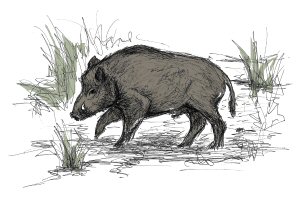
The pig was always highly prized for its tasty meat and in Irish legend it was the favourite meat of the Gods and heroes at their feasts in the otherworld. It was also greatly respected for its bravery and fierce spirit when defending itself and for this reason was one of the symbols of the warrior.

In Irish Folklore the pig is seen as a lucky animal and they were also able to see the wind and forecast the weather, they were also said to have magical hearing and they could actually hear the grass growing.

Evil or threatening spirits were often said to appear in the form of a black pig and it was believed that this was the worst of all forms for fairy folk to take so people would carry a hazel stick to ward of the evil spirits. This time of year (Halloween/Samhain) when the barriers between this world and the next are weakest is a favourite time for the Black Pig to be abroad so you would be wise not to travel alone at this time.

The pig occurs in Irish folk cures. A cure for a child with mumps was to take it to a pigsty and rub it's head on the pigs back in the hope that the illness would transfer into the pig. It was also believed that a cure for a toothache was for the sufferer to put their head to the ground where a pig had been scratching its backside while making the sign of the cross with their mouth. If you did this you would never suffer from toothache again. Another disgusting cure for jaundice involved swallowing a dozen live lice from a pig.

The Gentleman Who Pays the Rent.

This is the euphemism that was once used in Ireland to describe what was often a family's most valuable possession - the pig.

Until the advent of the industrial age, most people lived a relatively agricultural life. In Ireland before the potato famine, cottagers who may not have been able to afford a riding horse or beef cattle would at the very least keep a few pigs. They were usually housed close to the main dwelling, and sometimes the pig house was attached to one end of the cottage.

Now you might be surprised to see this sort of housing arrangement but the pig was a very valuable part of the Irish cottage economy and pigs do best in warm, dry surroundings. So not only did this practice help keep the pigs (and often a milk cow and laying hens) warm and safe from predators, it was easier feeding kitchen scraps to the pig and hens and collecting manure which was both valuable and very necessary for growing healthy crops. Manure was in fact so valuable you stacked it outside the front of the cottage so you could keep your eye on it.

Pigs were butchered in the autumn , around Samhain. This meant that the animals wouldn’t need scarce fodder over the winter (stocking up enough hay was tedious and land-intensive for a small-holder). It also meant that the cooler weather would slow down spoilage until the salted meat could cure. Cottagers would preserve enough ham, bacon, sausage & lard to see them through the year, and sell the rest to the butcher. However, in poorer households, people did not eat their pig. They sold it to get money to pay the rent on their land. That is why the family's pig was often called "the gentleman who pays the rent."

“The “pig in the parlour” stereotype of Ireland came from the system landlords imposed more than three centuries ago of charging people extra rent for pig houses. The poor country people found that as a pig is a clean and intelligent animal, it could share a clay cabin without soiling it if allowed to come and go. Until recent times there was a tradition in rural Ireland of keeping one pig in the yard to eat the scraps and provide an extra source of food. The practice came to be associated with poverty and died out with the coming of supermarkets.”

Wednesday, October 20, 2010

The Hurley. Also known as the Camán.


The Hurley. Also known as the Camán

The earliest recoded reference of the game of hurley being played by the anciemt tribes of Ireland dates from 1800 BC to 1300 BC. First recorded in the ancient Irish Annals.

The Irish Annals are a body of work mixing Irish history with legend and mythology. The annals record in 1272 BC, that the strongest and most skilled warriors of the Tuatha de Danann defeated their rivals, the Firbolgs, in a hurley match to the death at The First Battle of Moytura. There were twenty-seven men on each side and when the game was over, the casualties were afforded a funeral of honour and were buried together under a huge stack of rocks known as a cairn, an ancient equivalent of our modern day monuments and burial headstones.

At the Second Battle of Moytura, the Tuatha de Danann leader, Nuada, would be killed by the Formorians, another of the original inhabitants of Ireland. Celtic Sun God Lugh, one of the Danann warriors, would emerge as a hero having killed the Formorian warrior, Balor, by shooting a stone into the giant’s eye.

Later, the Brehon Laws would declare the game of Hurley as a form of Irish military service. The laws asserted, if a man was killed or injured by a Hurley, either his surviving family or himself are eligible for life-long financial assistance. This could be considered the earliest example of a military disability or widow’s pension. Also stipulated in the laws, all sons of kings and chieftains were to be supplied with Hurley sticks during the traditional period of fosterage with another noble family.

In 200 BC The Irish Annals recorded the childhood exploits of King Lowry Loingseach. Lowry, said to be mute, only uttered his first words after being hit with a stick during a Hurley match. It is not known what he said but it is believed to be unrepeatable.

Around 100 BC, Cuchulain, an Ulster warrior, leader of The Red Branch Warriors and son of the Celtic Sun God Lugh and a human mother Dechtire, gained youthful fame on account of his hurling abilities. In one legendary incident, he single-handedly defeated one hundred and
Fifty warriors in a hurling match on the Field of Armagh.

Angered by their defeat, the men attacked Cuchulain, but he fought back killing fifty men with his bare hands before the others fled the field. Considered the greatest warrior of ancient Ulster, Cuchulain was known for his uncontrollable temper and physical deformities, such as having seven fingers on each hand and seven toes on each foot. He was said to go insane with uncontrollable rage and, during times of insanity, was reported as having seven pupils in each eye. On one occasion, he had reportedly carried the ball on the blade of his Hurley stick a distance of nine miles in a repetitious motion of throwing the ball into the air and catching it on his blade before it could drop to the ground.

Cuchulain was the nephew of King Conchobar. At the age of seventeen, Cuchulain singularly defeated the forces of Maeve, warrior Queen of Connacht, when she tried and failed, in an attempt to capture Ulster. Tales of all kinds are told about him. At the age of twenty-seven Cuchulain, finally met his match when he was killed in an ambush. His attackers are said to have severed his head using the great warrior’s own hurley stick.

Hurley continued to be popular in Ireland but, according to the Irish texts, The Dun Cow 1100 AD, and The Book of Leinster 1160 AD, it was not until the 3rd century AD that the Irish had their next great Hurley warrior. Fionn MacCumhail, popularly known as Finn MacCool, was the mythical leader of the fighting band Fianna Eireann. MacCool is said to be a descendant of the god Nuada, former king of the Tuatha De Danaan. MacCumhail's most notable hurley accomplishment occurred when he defeated fifty men by scoring the decisive goal in a match at Tara. His reward for his deed was a kiss from King Cormac MacArt’s daughter - the woman he was to subsequently marry.

Even in the religious records of ancient Ireland one finds mention of hurley. Such is the example and story of the visit of Saint Colmcille to Tara. In the 5th Century Tara was reputed to have been a powerful and sacred place of gods and an entrance to the other world. During his time there, a Connacht prince used a hurley to kill a young boy. Although Saint Colmcille attempted to intervene, the prince was summarily executed on the spot, for such was the anger of those who had witnessed this savage act.

Hurling eventually evolved into a sport and was played by teams representing neighbouring villages. The teams could be made up of all the available males capable of holding a stick and might have lasted several hours. They were usually for the honour of the village, to settle disputes or for entertainment value.

It has been held in high esteem throughout the ages and has become one of our national games supported by huge armies of fans flying their county colours and promoted all over the world by The Gaelic Athletic Association.

It has to be one of the fastest team sports played today, exciting and a little dangerous it is the embodiment of the Irish spirit. The game of Camogie played by women is almost identical to the game of hurling and is both as exciting and as popular. If you get the chance to watch a game or better still go to a game and join in the crowd excitement then don’t hesitate.

Tuesday, October 19, 2010

Bataireacht. Irish Stick Fighting.


Bataireacht. Irish Stick Fighting.

Bataireacht. Our native Irish martial art. Since a cane or walking stick can be carried easily in modern society bataireacht can be used as an extremely effective weapon. Bataireacht or Irish stick fighting as it is also known (from the Irish Bata, meaning stick) is a traditional form of Irish martial art using a stick. The most common types of wood used were oak, ash, hazel and of course blackthorn. Down through the centuries we have used various sticks or cudgels and the one that most people would be aware of is the shillelagh.

Irish stick fighting came into its own sometime around the 17th century when we were banned from owning formal weapons. At that time the innocent walking stick called a bata or shillelagh came into use as a serious weapon and stick fighting became an integral part of our fighting style. In the 19th century bataireacht became associated with gang or “faction” fighting. Some evidence exists which indicates that prior to the 19th century the term had been used to refer to a form of stick fighting used to train Irish soldiers in broadsword and sabre techniques. Although stick fighting is a free style form of combat there are certain patterns and family styles in existence.

The basic idea behind the use of the bata is to charge, strike and disarm your opponent aiming for the vulnerable points such as joints, shoulders, knees and temple or for areas where nerves could be struck. You can use the bata one handed which was the traditional method, although some will use the bata with both hands using a two handed grip (a little awkward). As with a lot of the various martial arts bataireacht has become tainted by Hollywood in such films as The Gangs of New York and it has been made out to be a brutish form of fighting instead of the very precise and extremely well executed defence system it becomes in the hands of a well trained and disciplined practitioner.

No known textbooks for the use of bataireacht exists but its use has been reconstructed using sources that include introducing various forms from other stick fighting styles such as escrima (a Filipino stick fighting system) and Canne de combat (a French style). There is still a style that has been passed down by the Doyle family by the name whisky stick dance where the stick is held with a two handed grip. Cumann Bata is an organisation teaching a one handed version which they have reconstructed where the hand is approximately a third of the way from the end of the stick and the stick is held just above the head.

The Bata used to be our weapon of choice before the gun arrived, It was cheap and readily available and the walking stick or long staff could be carried anywhere and so was always by your side if you needed to defend yourself. Women could carry it just as well and this would have been quite normal in Irish society. The word Shillelagh was actually coined by an Englishman (or so the story goes). The original stick of that name came from the Shillelagh forest in County Wicklow, where the forest was once famous for its stands of fine oak trees.

Sometimes the knob on the end was hollowed out and filled with molten lead, which was known as a 'loaded stick'. However, in shillelaghs made of blackthorn, the knob was actually the root, and it would not have been necessary to load it as it could pack a significant wallop. The bark is left on for added strength and a metal end is attached to the bottom. During the curing and drying process, sticks would be buried in a manure pile or smeared with fat and placed in the chimney. The bata was taken up by Irish boys when they became of age, it was seen by some as representing their passage into manhood and they would practice their fighting techniques as a way of demonstrating their right to be a warrior.

Irishmen would take their shillelagh just about everywhere they went; however, it was at a fair, a wake or a feast day celebration that it was most needed. Up until the great famine of the 1840's, faction fighting was always present at most social gatherings. The factions were mostly members of certain families, political groups or territorial gangs. Sometimes the fights would consist of hundreds of men; women would participate by wielding a stocking filled with stones. After the 1840's, the faction fights gradually died off and the last recorded one was held at a fair in Co. Tipperary in 1887.

Shillelagh fights were not always of the faction variety. Some were sporting events, while others were provoked just for fun. These were friendly fights sometimes ending up somewhat rough, although it was rare for a participant to need the aid of a doctor.

If you have a shillelagh made of oak, ash, holly or blackthorn, you do indeed have an authentic shillelagh. The short, stubby ones sold in souvenir shops are not real shillelaghs.