Tuesday, July 20, 2010

Oisín and Tír Na nÓg.


Oisín and Tir Na nÓg.

The direct translation of Tir Na nÓg is "land of eternal youth". It refers to a mystical land in Irish mythology where the trees are always in bloom and there is always a bard to sing for you, where the food is always bountiful and the drink is always flowing, and, most of all, a place where you'll never grow a day older. You may live for blissful eternity in this enchanted land.

The favourite legend of Tir Na nÓg is that of the love between Niamh (pronounced Neeve) and Oisín (O-Sheen), a goddess and a Celtic warrior, whose love story takes them across the ocean, through the ages, and into legend.

One day while out hunting, Oisín was approached by a beautiful maiden, Niamh. The couple fell in love and travelled on Niamh’s magic white horse to live in Tir Na nOg. They married and lived a long and happy life together in this enchanted land.

300 years had passed and Oisín still looked exactly the same as when he arrived to Tir Na nOg. But even the land of eternal youth couldn’t banish memories and he began to miss his people and his home terribly. Niamh understood his need to visit the mortal world again and see his friends and she provided him with a fairy horse to take him there. She warned him however that he must not set foot on the earth – if he did, he would never be able to return.

Oisín arrived back in Ireland to see that much had changed over 300 years! Fionn and his men were long dead and the Fianna were by now the stuff of legend. He did not like what he saw and decided to return to Tir Na nOg and his beloved Niamh. On his way back he came across a group of men who were attempting to lift a heavy rock and he bent down to help them. Tragedy struck as he slipped from the saddle and fell to the ground. Oisín had touched mortal soil. He was instantly transformed into an old blind man.

Oisín wandered Ireland for many years; eventually he was to die without ever again setting eyes upon Niamh and Tir Na nOg. Here the story of Tir Na nOg ends. Unfortunately eternal youth is for fairies and not mortals - but that shouldn’t stop us dreaming!

Lughnasa.


Lughnasa.

The Reek.

Long before St Patrick’s visit in 441, the Reek was known by its ancient name of Cruachán Aigli. Cruach’ in English is a variant of ‘rick’ or reek, or stacked-up hill and refers to the cone-shaped mountain. Some translators took ‘Aigli’ to mean ‘Eagle’.

On foot of this interpretation, the coat of arms for Westport town incorporates an eagle and, in the nineteenth century, part of the ridge extending eastwards from the peak or Reek was still called Mount Eagle.

The name Cruach Phádraig started to gain prominence over Cruachán Aigli from the tenth to the thirteenth century. In the sixteenth century when many Irish place names were given an Anglicised version, Cruach Phádraig became widely known as Croagh Patrick.

Pagans celebrate the harvest with the festival of Lughnasa, held in honour of the god Lugh and whose name is now encompassed in the Irish for August (Lughnasa). (Nasa means games or an assembly). This festival took place throughout the country, often in high places such as The Reek.

Locally the festival became known as Domhnach Chrom Dubh (Black Crom Sunday. Crom Dubh features in legend as a pagan god.), Garland Sunday, the last Sunday of Summer, Domhnach na Cruaiche (Reek Sunday).

The Boheh Stone

In 1987 Gerry Bracken (a local historian) discovered that while standing at the Rock of Boheh which is about 7km (just over 4m) from Croagh Patrick, that the setting sun, rather than disappearing behind Croagh Patrick, actually rolls down the north slope of the mountain. This phenomenon lasts about twenty minutes and occurs on the 18 April and 24 August each year. These two dates, with 21 December, split the year into three equal parts and it is thought that they were used to celebrate sowing and harvesting seasons.

The spectacle of the rolling sun in prehistoric times probably merited the inscription on the Boheh rock outcrop, depicting many cup-and-ring marks, making it one of the finest examples of Neolithic rock art in Ireland and Britain

Winter Solstice

Less than a kilometre from Croagh Patrick is the ancient ritual site of Annagh, Killadangan, which has a standing stone row at its centre. This stone row aligns with the setting sun at 1.40pm on 21 December each year. The sun sets into a notch on the east-ridge of Croagh Patrick. On the same day as the rising sun is celebrated at Newgrange, the setting sun retires to its sacred celestial home at Croagh Patrick.


Before 1113 AD Lent or St Patrick’s Day (March 17th ) was the accepted time of year to make a pilgrimage to Croagh Patrick, but in this year a thunderbolt is said to have killed thirty of the pilgrims and the pilgrimage period was changed to summer, the most popular dates being the last Friday or Sunday of July. This story can be seen as an example of the old pagan gods gaining revenge on their Christian usurpers.

Although Croagh Patrick was originally a pagan sanctuary for the celebration of life’s abundance, under Christianity it became the scene of penance for supposed sinfulness. Many of the Christian pilgrims ascended the mountain barefoot, or even on their knees, as an act of atonement. The positive aspects of the original Celtic Lughnasa celebrations have been warped by the Catholic Church, imposing negative and alien concepts of control, fear, and guilt.

Sunday, July 18, 2010

The Love Flower.


The Love Flower.

There is in the west of Ireland a flower called the love daffodil.

Most daffodils bloom in Spring time, a beautiful yellow that lifts it's head to the spring sun and follows it until the sun sets in the west. Then slowly closes its petals and droops its head toward the ground until the sun rises the next morning.

The love daffodil pushes through the snow in January and is buffeted by cold winds and shone down upon by an icy sun. The colour of the love daffodil is red. Some say if you find it on a clear frosty night in a full moon, blood drips from its petals to the snow covered ground.

You may ask why there is such a sad flower as this that grows alone in the middle of winter before even the crocus heralds the spring.

It all happened a long time ago.

There once was a rich farmer whose wife gave birth to a beautiful baby girl. They called her Caithleen.

It was fortunate indeed that she inherited her mother's looks and her father intelligence. She grew up without her mother’s vanity for her mother was very vain and was considered a great beauty.

Everywhere her father went Caithleen would follow listening to every word that was spoken. The workers loved her for she had a great memory for names. From the oldest man or woman whom she addressed as Mr or Mrs. to the youngest baby of the tenant farmers.

The girls were jealous of her long black hair dark eyes and skin as smooth as velvet, yet for all that, they liked her. The boys would blush and stutter in front of her not sure what to say to one so beautiful.

Her vain mother watched all that was happening and became envious of her daughter. The more her own beauty faded the more she made plans to be once more called the most beautiful of all Ireland.

One day as Caithleen was away on some errand she spoke to her husband.
"Husband," she said, "you are indeed a rich man."

He nodded, tapping his pipe on the heel of his shoe. "I have been blessed many times over. You, a beautiful and devoted wife, a daughter that I love and land that yields plenty."

She watched him slyly as he gazed contentedly into the fire. "I hear," she said, "there are vagabonds on the roads ready to take innocent young girls for ransom."

Her husband stared at her in horror. "Ransom?"

"Yes, all the gold you can find and when they get it they kill the poor innocent ones."

"Oh I could never let that happen to my beloved Caithleen. I will hire guards to protect her."

"That will not help," cried his wife, "for there are too many of the thieves."

"Then wife what are we to do?"

His wife turned away so he couldn't see the look of glee on her face. Her voice was sad. "For her own good she must be locked up in the dungeon where none may find her."

"Never!" Cried her husband, "Caithleen is like a flower, she needs the rain on her face and the warm summer sun to bloom. I will ponder on this vexatious question."

So ponder he did for a whole month driving his wife mad with his indecision. Then one day he made up his mind. "I will build a room for my beautiful Caithleen on top of the house. From there she will see all the countryside while none will be able to gaze on her. That way she will be safe from thieves and vagabonds."

Unhappy though she was being locked away, she did her father’s bidding and settled in the room at the top of the house.

The seasons came and went. Spring with a sea of bluebells, summer with rolling hills of purple heather and long stalked rushes with balls of seed stuck to the top. Autumn with the golden fields of wheat and winter when the ground slept.

Years passed and Caithleen grew more beautiful while her mother, with her sly ways turned into a very cranky woman because everybody kept asking for her daughter, never once mentioning how beautiful she was.

One Winters day her husband declared that he must have the thatch on the roof repaired.

With fear in her heart his wife gripped his arm. "But husband if the Thatcher climbs the roof and sees your daughter he will tell the whole country."

Her husband had aged a lot because he missed having his daughter by his side yet he could still smile. "Worry not wife, I have fixed everything."

The next morning as the sun climbed into the blue frosty sky, Caithleen was awoken by the sound of singing.

She looked out the window and saw a young man about her own age working away pulling out the old thatch and replacing it with new. His hair was the colour of the straw that he matted with his fine strong hands.

He sang of the flight of the swallow and the music carried her to where the bird soared and knowing the song she joined in.

"'Tis a beautiful voice you have," he said when the song finished.

Caithleen blushed. "Thank you, so have you. I've not seen you around here before."
With nimble feet he climbed the roof to where she stood at the window. "I'm from the next county, my name is Seamus." His smile was wide and happy.

Caithleen gave a start. His eyes were grey, plain grey. He was blind.

"Be careful you might slip!"

Seamus stood, sure footed, the smile growing ever wider. "I haven't fallen off a roof yet and I'm the best Thatcher in all of Ireland."

Caithleen smiled. "You're very sure of yourself."

Seamus grinned. "I must get back to work or I'll have no job by sunset and you must get to your work or you'll get into trouble."

"Oh, I.” Caithleen blushed. "Yes, I'd better."

Over the next days and weeks Caithleen and Seamus used to meet and talk and sing. Funny thing, no-one in or around the house could hear them yet, people out in the fields would stop and listen and wonder what kind of new bird had come to Ireland.

It was a grey day and late snow had started to fall. Seamus climbed up the roof to the window where Caithleen stood.

"Tis my last day Caithleen, I've come to say farewell."

She wiped away the tears that ran down her face. Caithleen had fallen deeply in love with the handsome blind Thatcher and had thought of all the ways she could stop him leaving.

"I've brought you a present," he held out his hand, "'tis the first flower of spring." The yellow daffodil shone out against the snowflakes that fell around him. Cathleen reached out and for a brief moment their hands touched.

"Caithleen, you have the most beautiful singing voice and when you speak I can feel the caring in it. At night I dream of what you might look like."

Seamus paused, searching for words. "I wonder - before I go could I touch your face, just once?"

Wordlessly Caithleen reached out for his hand and guided it to her cheek. His touch was feather light as he traced her hair, the shape of her eyes, her nose. His fingers lingered on her lips. Gently she kissed each one.

"What is going on here?"

Caithleen's mother strode into the room and seeing her daughter about to kiss the blind Thatcher screamed. "Get away from her."

She dragged her daughter away from the window and with a great heave threw Seamus down the roof. He tried to get a foothold but the snow, now thick made it too slippery.

Pushing her mother aside, Caithleen leaned out the window and watched her beloved slip over the side.

Beneath him was the last of the straw for the roof held together by stakes stuck in the ground.

His last word before his body was impaled was her name. "Caithleen!!"

With a cry of despair and still clutching the daffodil she leapt from the window. Down, down she slipped, her eyes never leaving the body of Seamus.

Her father found them, both impaled on the same stake, face to face, their lips touching. Between them lay the daffodil covered with their blood. With a breaking heart he buried them side by side on the hillside overlooking the farm. It was talked about near and far, the beautiful smiles they had on their faces.

If you suffering a broken heart, go to the West of Ireland in Wintertime. Search for the blood red daffodil. If you find it, hold it close to your breast and it will heal all unhappiness.

Thursday, July 8, 2010

Cilliní / Children's burial ground.


Cilliní or Children’s burial ground.

The phrase "Children's burial ground" refers to an unconsecrated place used primarily, though not exclusively, for the burial of unbaptised children. Those most commonly used in Co. Mayo are cillin/Killeen, lios/Lisheen. The word cill is derived from the Latin cella, and means Church or Graveyard. (History of Mayo).

Old Burial Grounds:

The custom of setting apart a special place for the burial of very young or unbaptised children appears to have been common practice in Ireland until the 19th century. Numerous such burial grounds, known as Children's Burial Grounds, Cillíní, Calluraghs, Caldraghs or Cealhúinacha, are recorded on the Ordnance Survey maps, particularly in the west of Ireland.

Frequently the locations chosen were abandoned Early Christian church sites or ringforts, but children were also buried in such places as haggards and fields, boundary fences, cross-roads, under lone bushes, in cliff-clefts, on the sea-shore or outside a graveyard wall. Children's burial grounds are frequently located within a pre-existing early ecclesiastical site or ringfort.

Those sites which are not associated with an older monument are usually marked now by little more than an area of uncultivated stony ground, often raised above the general surroundings.

Within the burial grounds, the individual graves may be marked by a low mound or by a low uninscribed standing stone and sometimes the graves themselves are visible above ground as small box-like arrangements of stones. The presence of quartz pebbles is also a common feature. It was said that little coffins were brought in the night and the only sign that a burial had taken place was a newly made grave. This practice stopped around 1900

Local folklore relates that adults, particularly strangers or suicides, were sometimes interred in these burial grounds. The Ordnance Survey recorded many instances of the continued use of children's burial grounds into the 19th century and an example of the custom was recorded in Co. Mayo as recently as 1964. When the custom began in this country has not yet, however, been established.

Cilliní:

Cilliní were the designated resting places for individuals considered unsuitable for burial within consecrated ground by the Roman Catholic Church. Traditionally associated with the burial of unbaptised infants.
The saddest of all customs were those that dealt with the death of babies and young children. Unbaptised babies could not be buried in consecrated ground so they were buried between sunset and sunrise outside the walls of the graveyard or in a disused graveyard, a cillín or a ring fort.

The souls of the little babies were said to be cursed to carry a candle forever. These baby-lights were often seen at night outside graveyards especially in the month of November. People were led to believe by the religious that the lonely little souls were searching for their parents or relations inside the graveyards but they could never enter as they were unbaptised.

Up to fifty years ago in some areas, unbaptised babies were buried in the path around a graveyard. Parents did not go to the grave with the dead child particularly if it was their first child. They believed that if they brought one child to the grave they would bring the next and possibly all their children there also. Should more than two infants from the same family be born dead the cycle could be broken by changing the place in which the infants were buried.

Tuesday, July 6, 2010

The Kilkenny Witch.


Dame Alice Kyteler.
The Woman at the Centre of Ireland’s First Witch Trial (1324-1325)
The case of Dame Alice Kyteler was one of the first European witchcraft trials and the first recorded claim of a witch having intercourse with demons, although the charges were almost certainly trumped up by those seeking her money. Kytler herself escaped, but others in her household were less fortunate.

Dame Alice Kyteler was born in 1280 at Kyteler's House in Kilkenny, Ireland, the only child of an established Anglo-Norman family. She was a wealthy and beautiful Irish noblewoman, and was married four times, to William Outlawe, Adam le Blund, Richard de Valle and, finally, to Sir John le Poers. When Sir John was taken ill, he suspected he was being poisoned, and on his death, Alice’s step-children accused her of using poison and sorcery against their fathers, and of favouring her first-born son, William Outlawe Jr. In addition, she and her followers (ten of her servants and her son, William) were accused of denying the Christian faith, sacrificing animals to demons and blasphemy. There were some rather bizarre specific claims, included the mixing in a robber’s skull of magical ointments made from worms, hairs from buttocks and clothing from unbaptised baby boys, and alleged intercourse with a demon named Robin or Son of Art, which reportedly appeared as a black shaggy dog or as three Ethiopians carrying iron rods. Various powders, charms and incantations were also found at her home.

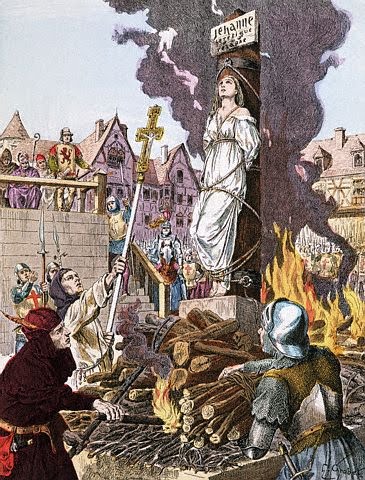
The case was brought in 1324 before the then Bishop of Ossory, an English Franciscan friar called Richard de Ledrede, but Dame Alice’s network of influential friends deflected the accusations and even had the Bishop arrested. John Darcy, the Lord Chief Justice, travelled to Kilkenny to investigate the events and vindicated the Bishop, who again attempted to have Dame Alice arrested. Although convicted in 1325, on the night before she was to be burned at the stake, she escaped to England, and was never heard of again.

The Bishop, however, continued to pursue her followers, bringing charges of witchcraft against them, and Alice’s son William Outlawe (who was accused of heresy, usury, perjury, adultery, clericide and other misdemeanours), was convicted but escaped relatively lightly after recanting his heresy and sorcery, being ordered to hear three masses a day for a year, to feed the poor and to pay for a church roof to be covered with lead. Her lower-class followers were less fortunate, and one of them, Petronella de Meath, was tortured by whipping to obtain incriminating information against her mistress, and finally burned at the stake on 3 November 1324, the first person in Ireland to be executed by this method. Ironically, Ledrede himself was later was accused of heresy.

This was one of the first European witchcraft trials and followed closely on the election of Pope John XXII to the Papacy, and his addition of witchcraft to the list of heresies in 1320. It also contained the first recorded claim of a witch having intercourse with her incubus. Although the trial itself did not spark immediate, widespread witch-hunts, suspicions of conspiracies with demons, such as those against Kyteler, would be revived in years to come against other reputed witches.

Monday, July 5, 2010

The Sin Eater.


The Sin Eater.
A sin-eater is a traditional type of spiritual healer who uses a ritual to cleanse the dying of their sins. The sin-eater absorbs the sins of the people he or she serves and typically works for a fee. As the sins are usually consumed through food and drink, the sin-eater also gains a meal through the transaction.

Sin-eaters are often outcasts, as the work may be considered unsavoury and is usually thought to lead to an afterlife in hell due to carrying the un-absolved sins of others. The Roman Catholic Church regularly excommunicated sin-eaters when they were more common, not only because of the excessive sins they carried, but also because they infringed upon the territory of priests, who are supposed to administer Last Rites to the dying according to Church Doctrine.

A sin-eater typically consumes bread as part of the ritual of taking on the dying person's sins. He or she may also eat salt or drink water or ale. Sometimes, special breads are baked for the purpose of the sin-eating ritual, perhaps featuring the initials or image of the deceased. The meal is sometimes passed over the dead or dying body or placed on its breast to symbolize its absorption of the person's sins. The sin-eater may also recite a special prayer.

As a shamanic tradition, a Sin Eater would be employed by the family of a deceased person, or sometimes by the church, to eat a last meal of bread and salt from the belly of the corpse as it lay in state. By so doing it was believed that the sins of the dead person would be absorbed and the deceased would have clear passage to the hereafter.

The Sin Eater was given a few coins for his trouble but other than that was avoided (literally ‘like the plague’) by the community who regarded him as sin-filled and unclean as a result of his work. That is why Sin Eaters usually lived at the edge of the village and children were warned away from them. One other point of interest, who would eat the sins of the sin eater? for his sins were the accumulation of all the sins he had eaten through his/her life.

The Sin eater seems to have been mostly associated with the Celts of Wales and its borders with England. There have been stories of Sin eaters in Ireland and Scotland long ago.

Thursday, July 1, 2010

An FIr Gorta.


An Irish Tale.

The dead have always played a central role in rural Irish folklore. Whether as insubstantial ghosts wandering through the countryside or walking corpses returning to torment the living, our former ancestors have always exercised an intense and continuing fascination for those who survive them and have formed the basis for many hair-raising tales.

The dead, it appears, will not go away. The belief in returning ghosts, spirits or corpses may have its origin in primitive ancestor worship. It was well known throughout the country that the dead had to be looked after at all times. Not to do so was to invite misfortune upon yourself, your family or your community. Nor has this belief wholly died out.

In 1993, there was an old man in north Cavan who claimed that, as a child, he remembered the corpse of his grandfather coming back from the grave on some nights during the winter months to sit at the fire and smoke a pipe of tobacco. He said that he also remembered actually touching the skin of the corpse and finding it very cold. His grandfather never spoke but sat warming himself by the fire. The rest of the family ignored this and went off to bed, leaving the corpse sitting in front of a good blaze. When they got up in the morning, the corpse was gone - presumably back to its grave. This story was borne out, without prompting, by one of the old gentleman's sisters.

Here is a story told to us as children in County Mayo and passed down through the family.

The Fír Gorta.

The Fír Gorta, The Man of Hunger in the English, was a tall thin looking feller who travelled around from place to place, village to village, town to country. He would knock on your door and as was our custom the stranger would always be welcomed and given a bite to eat, now as you know during the famine if food existed it was as scarce as hens teeth so some people would hide if they heard a knock on the door and some would deny they had anything in the house at all and some would even refuse to open the door. Some would even run him from the door.

For those people there would be no hope for they would perish in the famine, but there were those who would have a small piece of potato or a drop of milk and even though it might have to do the whole family our custom was one of hospitality to the stranger and so it would be offered to him. He would thank them for their generosity, politely refuse their meagre offerings and take his leave of them. Before he left them he would say, “Because of your generosity and your honest welcome you are truly blessed this day and neither you nor your family will ever die of the hunger. Tell none of this, but from this day forth your pot will never be empty and your jug will never run dry.

In the morning the mother went to the pot and within it found a great big potato that would feed the whole family and the jug brimming over with fresh milk and every morning from then on it was the same thing. They survived the hunger.

We were also told to always carry a piece of bread in our pocket because sometimes when out walking the boreen if you felt hungry it meant you were passing a place of famine death and if you did not eat something straight away then you would waste away and die.