Friday, May 27, 2011

The Otter. Madra Uisce.


The Otter. Madra Uisce.

The otter lives along riverbanks and beside lakes all around Ireland. It is very good at swimming and diving. The otter has a small-flattened head, a long thick neck and a thick tail that narrows to a point. It can be 3 feet in length, which is about a metre and when they are fully grown up they can weigh about 20 lbs. It has a long body covered with fur. It belongs to the same family as the stoat, pine marten and badger. The otter looks like a seal. The otter is a carnivore, which means that he usually eats meat and often eats shellfish. To get at the shellfish,the otter bangs it against a stone. This way he can get at the food inside. The otter is found in many parts of Ireland. Otters are very playful animals. It has a grey to brown thick coat of fur, which helps it swim well in water. They are often seen jumping in and out of water just for fun,

The Dobhar-chu (see my post 26th-Oct-2010).

In Irish folklore, the Dobhar-chu (say durra-ghoo) is the king of all otters, the seventh cub of an ordinary otter. It is said to be much larger than a normal otter, and it never sleeps. The king of all otters is so magical that an inch of its fur will protect a man from being killed by gunshot, stop a boat from sinking or stop a horse from being injured.

The Dobhar-chu is also often said to be accompanied by a court of ordinary otters. When captured, these beasts would grant any wish in exchange for their freedom. Their skins were also prized for their ability to render a warrior invincible, and were thought to provide protection against drowning. Luckily, the Otter Kings were hard to kill, their only vulnerable point being a small point below their chin,(first you had to get past those sharp teeth). There are also traditions of the "King Otter", who is dangerous, and will devour any animal or beast that comes in its way. This otter is sometimes described as white with black rimmed ears and a black cross on his back, and sometimes as pure black with a spot of white on his belly. He could only be killed by a silver bullet and the person who killed him would die within 24 hours.

It was believed that if you were bitten by an otter then the only cure was to kill and eat another otter.

The otter is protected under Irish law and it is a criminal offense to kill one.

The otter is a loyal mate and a good parent who will after its cubs for longer than most other animals and for this reason is a symbol of a strong family.

The otter is sacred to the Irish sea god Manannan Mac Lir and the goddess Ceridwen.
Irish harps used to be carried in bags made from otter skin as it protected them from getting wet.

A warrior’s shield would be covered in otter skin (lining the inside) and in this way they protected the warrior in battle.

It was believed that the magical power of the otter’s skin could be used for healing. It was used to cure fever, smallpox and as an aid in childbirth.

If a person licked the still warm liver of a dead otter they would receive the power to heal burns or scalds by licking them.

The Wounded Otter.

by Michael Hartnett - translated from the Irish by the Author
From 20th Century Irish poems selected by Michael Longley. Published by Faber and Faber.

A wounded otter on a bare rock a bolt in her side,
stroking her whiskers stroking her feet.
Her ancestors told her once that there was river,
a crystal river, a waterless bed.

They also said there were trout there
fat as tree-trunks and kingfishers
bright as blue spears -
men without cinders in their boots,
men without dogs on leashes.

She did not notice the world die nor the sun expire,
She was already swimming at ease in the magic crystal river
.

One of his country's best-loved poets, Irish born Michael Hartnett, died in October '99 in Ireland. He was 58 years old.

Tuesday, May 24, 2011

The Donkey. Asal.


Donkey. Asal.

May the frost never afflict
your spuds,
may the outside leaves of your cabbage always be
free of worms,
may the crows never pick your haystack,
and may your donkey always be in foal

Old Irish Proverb


Christian tradition hold that donkeys originally had unmarked hides, and that it was only after Christ's entry into Jerusalem on the back of a donkey that they received the dark cross on their backs.

The hairs from the cross were widely believed to cure a number of ailments, and were often worn in a charm around the neck to guard against whooping-cough, toothache, fits, and to ease teething pains in babies.

Riding a donkey was also believed efficacious, especially if the rider faced the donkey's tail end, and was sometimes used as a preventative for toothache, measles and other children's complaints.

One cure for whooping-cough stated that the patient should be passed under a donkey and over its back either three or nine times; the trick of feeding an animal some of the patient's hair to transfer the illness was also used with donkeys. The donkey was also used to help cure the complaints of other animals; letting a black donkey run with mares in a field was thought to stop the mares miscarrying.

An old saying claims that no-one ever sees a dead donkey, this stems from the belief that a donkey knows when it is about to die and hides itself away. However, there is also a tradition that to see a dead donkey means great good fortune, and even as recently as this century it was considered a good-luck charm to leap over the carcass of a dead donkey three times

"If a donkey brays in the morning,
Let the haymakers take a warning;
If the donkey brays late at night,
Let the haymakers take delight."


A pregnant woman seeing a donkey - the child will grow wise and well behaved.

When a donkey brays and twitches its ears, it is said to be an omen that there will be wet weather.

When a pregnant woman sees a donkey, her child will grow up well behaved and wise.

In Ireland Mothers would wear a strip of donkey skin and a piece of hoof around their neck as a talisman against harm.

In County Mayo they believed that the spot on a donkey’s leg was put there by Our Lady’s thumb.

If two people with the same surname get married they can cure jaundice by placing a donkey’s halter on the afflicted person and leading them to a well. The person is then made to drink the water three times from the well.

A donkey that won’t stop braying and twitching its ears is an omen that rain is on the way.

A child sitting on the back of a donkey that circles nine times will be cured of whooping cough.

Hairs from a donkey’s back cure fits, convulsions, toothache, and teething trouble in babies.

The right hoof of a donkey protects against epilepsy.

Feeding a donkey the hairs from a patient cures the patient of scarlet fever.

One of the main uses for the donkey in Ireland was for carrying turf, seaweed or milk churns and it is for this reason that it became a symbol of the Irish countryside. In 1743 an act of parliament was passed, to kill a donkey carried a sentence of death.

It was also valued for its milk as it was considered a cure for tuberculosis, whooping cough; gout and improving the skin (remember Cleopatra).

The skin of a donkey was used to make shoes, sieves and bodhráns (drums).

Today you will mainly see donkeys in the countryside but now they are usually kept as pets although sometimes you may see them pulling the little donkey cart. For me there is a sense of nostalgia and beauty at this sight.

Sunday, May 22, 2011

The Stoat. Easóg.


Stoat. Easóg. Often referred to as ‘The Weasel’ in Ireland.

The Irish name Easóg refers to its eel like shape (eas is the Irish for eel) and when it runs its body undulates.

Rarely encountered in the flesh, but common in country tales, stoat packs have long hunted the borderland between folklore and natural history. It was once believed that the stoat was a form of cat brought to our shores as a pet by the Anglo-Normans.

The stoat has been present in Ireland since before the Ice Age, and possibly survived here through the Ice Age too. In fact, we have our very own sub-species, with a whiter belly, that is only found in Ireland and the Isle of Man.

On a mild, sunny day in March, a man was walking down a Yorkshire lane. Partridges were calling in the stubble, there was a blue haze in the air, and all was quiet in that part of the world.

Suddenly, as he walked, a pack of small animals charged down the bank into the lane and all about him. They leaped at him red-eyed, snapping little white fangs, leaping, dancing, darting, and as agile as snakes on four legs. Indeed, they looked like furry snakes, with their short legs, their long, undulating bodies, their little pointed heads, their flattened ears, rat-like tails and little murderous eyes.

The man laid about him with his stick. He knocked six or eight flying into the ditches on either side. He kicked off two or three that had fastened their fangs into his trouser leg. And those that he had knocked flying with blows that would have stunned a dog came out of the ditches and at him again. So, after a minute or two of this cut-and-thrust business, he took a good sharp run down the lane.

The man in question was Sir Alfred Pease, "a brave man who knows more about animals than most", and it was thus that J Wentworth Day described, in the 1930s, Sir Alfred's encounter with a stoat pack.

The stoat (Mustela erminea) is a member of the family mustelidae that includes weasels, ferrets, martens and otters. We are familiar with the paralysis it can inflict on rabbits, even at some distance, without knowing quite how it does it.

Well documented also is the stoat's whirling Dervish-like dance that mesmerises other animals until it darts forward and seizes one. Slightly less explicable is the dance that witnesses have reported the stoat performing as if in triumph over its already dispatched prey: "It ran round and round the dead bird," wrote one, "sometimes almost turning head over heels; then it would break away and race off into the bushes, then back out again." Stranger still is the fact that stoats carry their dead - appearing soon after one of their kind has been killed to drag the corpse into a hiding place.

It is perhaps such behaviour, along with their almost preternatural speed and flexibility, which have given stoats a slightly uncanny character. They are elusive, usually solitary animals; collectively, however, they can induce a feeling of menace.

No one is really sure why stoats occasionally form packs. The ability to hunt bigger prey is one obvious motive, yet as many stoat packs have been recorded in times of plenty - high summer for instance - as during hard winters. A female stoat hunting with her large brood of kits (usually between six and 12), or an accidental meeting of two family groups, giving a false impression of an organised pack, has also been suggested.

In Irish mythology, stoats were viewed as if they had human like abilities, as animals with families, which held rituals for their dead. They were also viewed as noxious animals prone to thieving and their saliva was said to be able to poison a grown man. They were even believed to understand human speech. So greet them politely or suffer the consequences.

To encounter a stoat when setting out for a journey was considered bad luck, but one could avert this by greeting the stoat as a neighbour.

Stoats were also supposed to hold the souls of infants who died before baptism

It was believed that if you killed a stoat its family would return and spit in the milk churn to poison it.

A purse or wallet made from the skin of a stoat was believed to bring great fortune for it would never be empty.

The skin of a stoat was said to cure rat bites.

If a woman cut off the testicles of a male stoat, stitched them into a wee bag and wore it round her neck it would act as a form of contraception. Well it would put me off.

We have a stoat that lives in one of our banks next to some stone steps. It has never harmed our chickens and ducks or to my knowledge any other of the wild birds. We have a blackbird that has a white spot on its shoulder and lives in a group of bushes near the stoat and he has been there about four years. The stoat is unusual as we have witnessed it a couple of times playing tag with a rat, as the two species are said to be sworn enemies it is this I find unusual. Recently we saw a smaller stoat, is this a female or are they breeding? I'll keep you posted.

Exams over, summer is upon us, time to relax.

Stoats are totally protected in Ireland. If stoats are proving a problem, by killing chicks or other domestic animals, you must solve the problem by using good fencing; it is illegal to kill a stoat.

Saturday, May 21, 2011

The Bear. Mathúin


The Bear. Mathúin.


Art, In Ireland a separate name from Arthur it comes from an ancient word for "a bear," used in the sense of "outstanding warrior" or "champion." A pagan High King of Ireland, Art's rule was so honest that two angels hovered over him in battle.

Bear folklore is widespread, especially in the far northern hemisphere. It is not surprising that this awesome beast was one of the first animals to be revered by our ancestors. From as far back as the Palaeolithic (around 50,000 years ago) there is evidence of a bear cult in which the bear was seen as lord of the animals, a god, and even the ancestor of humans. Various species of bear played a central role in many shamanic practices of the north, and brown bears were part of our native forests as recently as the 10th century, when hunting and habitat loss drove them to extinction.

The Celts venerated the bear goddess, Artio - like a mother bear she was a fiercely protective influence. The bear god Artaois is closely linked to the warrior-king, Arthur; with his legendary strength and fighting prowess, Arthur's name and emblem both represent this animal. Celtic families would often have their own animal totem, a tradition that is still evident in the family name McMahon, which means 'son of the bear'.

Viking warriors were famous for working themselves into an insane battle frenzy (it has been suggested that the psychotropic fly agaric mushroom was sometimes used, see one of my earlier posts). They invoked the bear spirit, at times even donning a bear skin, to imbue them with superhuman strength and fury. These were the Berserkers, their name being derived from a Norse word meaning 'bear shirt'.

Perhaps the most wonderful characteristic of bears is their ability to hibernate and then emerge at the end of winter, which suggests death and resurrection. In part because bears give birth during hibernation, they have been associated with mother goddesses. The descent into caverns suggests an intimacy with the earth and with vegetation, and bears are reputed to have special knowledge of herbs

In Celtic mythology, Andarta was a warrior goddess worshipped in southern Gaul. Inscriptions to her have been found in Bern, Switzerland as well as in southern France. Like the similar goddess Artio, she was associated with the bear. .

In Irish and Scottish mythology, Cailleach (also called Cailleach Beara or Cailleach Behr) was the "Mother of All". The word Cailleach means "old woman". She was a sorceress. In addition to the Celts, the Picts also worshipped her. In art, she was depicted as a wizened crone with bear teeth and a boar's tusks. Each year, the first farmer to finish his harvest made a corn dolly representing Cailleach from part of his crop. He would give it to the next farmer to finish his harvest, and so on. The last farmer had the responsibility to take care of the corn dolly, representing Cailleach, until the next year's harvest.

In Scotland, she is Cailleach Behr, The Blue Hag of Winter, an Underworld goddess and a faery spirit. She appears as an old woman in black rags carrying a staff, who travels about at night with a crow on her left shoulder. She has a bad temper and is dangerous to people. She has fangs and sometimes three faces. She could turn herself into a cat. One legend describes her as turning to stone on Bealtaine and reverting back on Samhain to rule as Queen of Winter. In another, she spent the autumn washing her plaid in her washtub, the whirlpool of Corryvreckan. By winter this was white, and became the white blanket of snow that falls over Scotland in January.

Bears are no longer found in Ireland (since the end of the eleventh century) or Scotland, they became extinct in the late Middle Ages. Bear amulets made of jet have been found in North Britain. Many times these were placed in the cribs of new-born babies so they would be under the protection of the Great Mother Bear. The Bear's strength and power made them a powerful totem symbol for the ancient Celts, and Bear's teeth were considered powerful amulets. Some Celtic sites had votive statues and ritual jewellery dedicated to the Bear.

The Celts had two goddesses that took the form of the Bear: Andarta ("powerful bear") and Artio. The Celtic god, Cernunnos is often depicted as being accompanied by a bear and other animals. The Druids called upon the blessings of the Great Bear, which is associated with the North. The reverence for Bears began to wain with the coming of Christianity, and was perverted into bear-baiting.

Phrases such as "licking a child into shape" comes from the belief that newborn bear cubs were small and fragile and their mother licked them into health and shape. The Bear Paw is also thought to secrete a substance that kept the bear through long winter hibernations.

Medieval "mummers" play the Bear as a villain, having him terrorize flocks of sheep. Bears have always been admired for their great strength, and their knowledge. Bears will stay away from trouble with humans if possible, but when cornered, they will fight bravely.

In medieval times, it was believed that a Bear's eye in a beehive would make the bees prosper and make more honey. Bears love honey, and often will brave the anger of the hive for a taste of their favourite nectar.

A child riding on the back of a Bear was thought to cure whooping cough.
Bears roamed Ireland thousands of years ago; a time when the entire island was almost totally forested. The Irish bear – the brown bear – was of the same species as the North American grizzly, and as such could reach heights of over eight feet when standing on hind legs. Bones were found in Glenade, in County Leitrim, in 1997 and at 3,000 years old are thought to be of the last bears to have lived in Ireland. The finding shows that bears lived on the island at the same time as humans; perhaps hunting and loss of habitat leading to their extinction.

Wednesday, May 18, 2011

The Raven. An Fiach Dubh. (including Crow).


Just for a bit of a change I am posting a series of animal posts.

The Raven. An Fiach Dubh.

In Irish folklore the Raven and the Crow was associated with the Triple Goddess the Morrigan and it was believed that the Raven/Crow that flew over the battlefield was the Morrigan. Some would consider her the protector; others looked upon her as the bringer of death. She was however the protector of warriors. Her message really should be that in war there can only be one winner and that is death. As a symbol of death the raven would be buried with its wings outstretched in order to symbolize the connection between this world and the otherworld and the raven as a messenger between the two.

Banshees could take the shape of ravens or crows as they cried above a roof, an omen of death in the household below.

"To have a raven's knowledge" is an Irish proverb meaning to have a seer's supernatural powers to see all, to know all and to hear all. Raven is considered one of the oldest and wisest of animals.

The raven was the favourite bird of the solar deity, Lugh. Lugh was said to have had two ravens that attended to all his needs.

Giving a child their first drink from the skull of a raven will give the child powers of prophecy and wisdom.

The raven, with its glistening purple-black plumage, large size and apparent intelligence has inspired man from ancient times. It is regarded as an omen of both good fortune and bad, carrying the medicine of magic. It is often associated with war, death and departed spirits. However, the raven has not always been associated with death, spirits and darkness. Quite the contrary, the raven was believed by some to be the bringer of light, truth and goodness.

A raven sits on the shoulder of Ulster hero, Cú Chulainn, to symbolise the passing of his spirit.

The Bible (Genesis, chapter 8: 6-13 of the Old Testament) tells how birds are sent by Noah to detect whether there is any dry land outside the ark that he had built to withstand the Flood:

At the end of forty days Noah opened the window of the ark which he had made, and sent forth a raven; and it went to and fro until the waters were dried up from the earth. This was the first recorded use of the Sat Rav (sorry, my sense of humour).

The druids would predict the future by studying the flight and the cries of the birds. The raven is believed to be an oracular bird, and a bearer of messages from the Otherworld. It is a symbol of the connection between this world and the next and it was said to represent the balance between life and death and the creation of the new.

Ravens are associated with knowledge, warning, procreation, healing, prophecy and are also a form favoured by shape shifters.

Finding a dead crow on the road is good luck.

Crows in a church yard are bad luck.

A single crow over a house meant bad news, and often foretold a death within. "A crow on the thatch, soon death lifts the latch."

When crows were quiet and subdued during their midsummer's molt, some European peasants believed that it was because they were preparing to go to the Devil to pay tribute with their black feathers.

Two crows would be released together during a wedding celebration. If the two flew away together, the couple could look forward to a long life together. If the pair separated, the couple might expect to be soon parted, too. (This practice was also performed using pairs of doves).

It has been said that a baby will die if a raven's eggs are stolen.

Ravens are considered royal birds. Legend has it King Arthur turned into one.

Crows feeding in village streets or close to nests in the morning means inclement weather is to come - usually storms or rain. Crows flying far from their nest means fair weather.

The Romans used the expression "To pierce a Crow's eye" in relation to something that was almost impossible to do.

An Irish expression, "You'll follow the Crows for it" meant that a person would miss something after it was gone.

The expression, "I have a bone to pick with you" used to be “I have a crow to pick with you".

A ritual for invisibility: Cut a raven’s heart into three, place beans inside each portion, and then bury them right away. When the bean sprouts, keep one and place it into the mouth. Invisibility occurs while the bean is inside the mouth.

Ravens facing the direction of a clouded sun foretell hot weather.

If you see a raven preening, rain is on the way.

Ravens flying towards each other signify an omen of war.

Seeing a raven tapping on a window foretold death.

If a raven is heard croaking near a house, there will be a death in it.

If a raven flies around the chimney of a sick person's house, they will die.

Many parts of Celtic Britain and Ireland view the raven as a good omen:

Shetland and Orkney - if a maiden sees a raven at Imbolc she can foretell the direction of her future husband's home by following the raven's path of flight.

Wales - if a raven perches on a roof, it means prosperity for the family.

Scotland - deerstalkers believed it bode well to hear a raven before setting out on a hunt.

Ireland - ravens with white feathers were believed a good omen, especially if they had white on the wings. Ravens flying on your right hand or croaking simultaneously were also considered good omens.

Raven is said to be the protector and teacher of seers and clairvoyants. In the past, witches were thought to turn themselves into ravens to escape pursuit.

Once upon a midnight dreary, while I pondered, weak and weary,
Over many a quaint and curious volume of forgotten lore,
While I nodded, nearly napping, suddenly there came a tapping,
As of someone gently rapping, rapping at my chamber door.
"'Tis some visitor," I muttered, "tapping at my chamber door -
Only this, and nothing more."


Extract from The Raven by Edgar Allan Poe

Sunday, May 15, 2011

Folklore of the Hedgerow. Part Twenty Two.


Rabbit . Coinín. Irish Hare. Giorria Éireannach.

A hare was a dreaded animal to see on a May morning. An old Irish legend tells of a hare being spotted sucking milk from a cow. The hare was chased by hounds and received a bad wound and it made its way into an old house to hide. When the house was searched all that was found was an old woman hiding a wound. The woman of the house had a central role in dairy production. From this fact springs the idea that women were those essentially involved in the theft of the farmers "profit". Old, widowed, unmarried or independent women were usually pinpointed as the main culprits.

Hares feature in Irish folklore, and the hare is older than our island’s culture itself. The Irish hare has been immortalised as the animal gracing the Irish pre-decimal three pence piece. Hare mythology exists throughout almost every ancient culture and when the first settlers colonised Ireland, the Irish hare was already an iconic figure. There are many examples in Celtic mythology, and storytellers still relate tales of women who can shape-change into hares.

The cry of the Banshee foretelling death might be legend but it may have parallels with the Irish hare of today as it struggles to avoid extinction in modern times.

Fertility rituals: place a rabbit skin under your bed to bring fertility and abundance to your sexual activities. If you're opposed to the use of real fur, use some other symbol of the rabbit that you're more comfortable with.

The obvious one -- a rabbit's foot is said to bring good luck to those who carry it, although one might argue that it's not so lucky for the rabbit.

To bring yourself boundless energy, carry a talisman engraved or painted with a rabbit's image.

If you have wild rabbits or hares that live in your yard, leave them an offering of lettuce, shredded carrots, cabbage, or other fresh greens. In some magical traditions, the wild rabbit is associated with the deities of spring.

Rabbits and hares are able to go to ground quickly if in danger. Add a few rabbit hairs to a witch bottle for protection magic.

In some legends, rabbits and hares are the messengers of the underworld -- after all, they come and go out of the earth as they please. If you're doing a meditation that involves an underworld journey, call upon the rabbit to be your guide.

Eostre, the Celtic version of Ostara, was a goddess also associated with the moon, and with mythic stories of death, redemption, and resurrection during the turning of winter to spring. Eostre, too, was a shape–shifter, taking the shape of a hare at each full moon; all hares were sacred to her, and acted as her messengers. Caesar recorded that rabbits and hares were taboo foods to the Celtic tribes.

In Ireland, it was said that eating a hare was like eating one’s own grandmother — perhaps due to the sacred connection between hares and various goddesses, warrior queens, and female faeries, or else due to the belief that old "wise women" could shape–shift into hares by moonlight.

The Celts used rabbits and hares for divination and other shamanic practices by studying the patterns of their tracks, the rituals of their mating dances, and mystic signs within their entrails. It was believed that rabbits burrowed underground in order to better commune with the spirit world, and that they could carry messages from the living to the dead and from humankind to the faeries.

As Christianity took hold in western Europe, hares and rabbits, so firmly associated with the Goddess, came to be seen in a less favourable light — viewed suspiciously as the familiars of witches, or as witches themselves in animal form. Numerous folk tales tell of men led astray by hares who are really witches in disguise, or of old women revealed as witches when they are wounded in their animal shape.
Although rabbits, in the Christian era, were still sometimes known as good luck symbols (hence the tradition of carrying a "lucky rabbit’s foot"), they also came to be seen as witch–associated portents of disaster.

Despite this suspicious view of rabbits and their association with fertility and sexuality, Renaissance painters used the symbol of a white rabbit to convey a different meaning altogether: one of chastity and purity. It was generally believed that female rabbits could conceive and give birth without contact with the male of the species, and thus virginal white rabbits appear in biblical pictures of the Madonna and Child. The gentle timidity of rabbits also represented unquestioning faith in Christ’s Holy Church in paintings such as Titian’s Madonna with Rabbit (1530).

From 1893 edition of Folklore: “Country people in Kerry don’t eat hares; the souls of their grandmothers are supposed to have entered into them.

Hares were strongly associated with witches. The hare is quiet and goes about its business in secret. They are usually solitary, but occasionally they gather in large groups and act very strangely, much like a group of people having a conference. A hare can stand on its hind legs like a person; in distress, it utters a strange, almost human cry which is very disconcerting to the listener. Watching such behaviour, people claimed that a witch could change her form at night and become a Hare. In this shape she stole milk or food, or destroyed crops. Others insisted that hares were only witches' familiars. These associations caused many people to believe hares were bad luck, and best avoided.

A hare crossing one's path, particularly when the person was riding a horse, caused much distress. Still, the exact opposite superstition claimed that carrying a rabbit's or hare's foot brought good luck. There is no logic to be found in superstitions.

The Hare.

Hares are considered unlucky, as the witches constantly assume their form in order to gain entrance to a field where they can bewitch the cattle. A man once fired at a hare he met in the early morning, and having wounded it, followed the track of the blood till it disappeared within a cabin. On entering he found Nancy Molony, the greatest witch in all the county, sitting by the fire, groaning and holding her side. And then the man knew that she had been out in the form of a hare, and he rejoiced over her discomfiture.

Or:

A tailor one time returning home very late at night from a wake, or better, very early in the morning, saw a hare sitting on the path before him, and not inclined to run away. He approached, with his stick raised to strike her, as he did so he distinctly heard a voice saying, "Don't kill it." However, he struck the hare three times, and each time heard the voice say, "Don't kill it." The last blow knocked the poor hare quite dead and immediately a great big weasel sat up, and began to spit at him. This greatly frightened the tailor who, grabbed the hare, and ran off as fast as he could. Seeing him look so pale and frightened, his wife asked the cause, on which he told her the whole story; and they both knew he had done wrong, and offended some powerful witch, who would be avenged. However, they dug a grave for the hare and buried it; for they were afraid to eat it, and thought that now perhaps the danger was over. However, the next day the man became suddenly speechless, and died before the seventh day was over, without a word evermore passing his lips; and then all the neighbours knew that the witch-woman had taken her revenge.

Top image:Madonna and Child with Saint Catherine (The Virgin and the rabbit). 1525-1530 Oil on canvas. Louvre, Paris
Source: hermitagemuseum.org


Lower image: Hare in The Moon.

Friday, May 13, 2011

Folklore of the Hedgerow. Part Twenty One.


Folklore of the Hedgerow. Part Twenty One.

The Bat. Laltóg.

Feared as creatures of the night associated with death, sickness and witchcraft. Made famous as the familiars of vampires by the cinema.

They sleep hanging upside down by their feet. They live in shelters such as caves or hollow trees, but they also take advantage of human structures. Like most small animals that are drawn to human habitations, bats have often been identified in folk belief with the souls of the dead. As a result, in cultures that venerate ancestral spirits, bats are often considered sacred or beloved. When spirits are expected to pass on rather than return, bats appear as demons or, at best, souls unable to find peace.

According to one well-known fable, popularly attributed to Aesop, the birds and beasts were once preparing for war. The birds said to the bat, “Come with us,” but he replied, “I am a beast.” The beasts said to the bat, “Come with us,” but he replied, “I am a bird.” At the last moment a peace was made, but ever since, all creatures have shunned the bat.

In relation to bats the learned folklorist Joseph Jacobs said “He that is neither one thing nor the other has no friends”Revulsion against them, however, is far from universal, and their quizzical faces have often inspired affection. There were no glass windows in the ancient world, and so people had little choice but to share their homes with bats.

In Ireland if a bat was seen near the house it was taken as a sign of an impending death for a member of the household. However, we have bats in our roof space (they came in last winter). We are quite happy with them and they cause us no problems whatever.

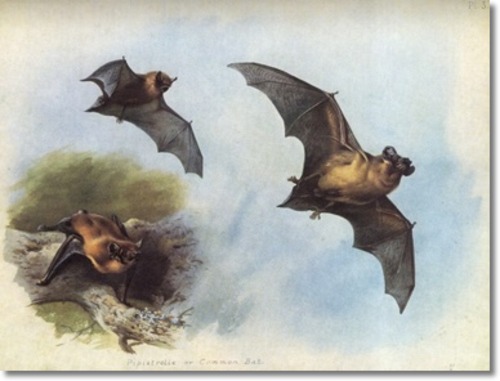
A common bat seen in and around hedgerows at dusk is the Pipistrelle Bat. Their Irish name is Laltog Fheascrach which means 'bat of the evening'.

Wood mouse. Luch fhéir / Luchóg.

The earliest remains of wood mice in Ireland, date to the Stone Age, 7600 years ago. It is believed that more wood mice came to Ireland with humans at various times, giving a certain genetic variability. The wood mouse is a very important part of the Irish food web. Many Irish predators eat wood mice, including owls, kestrels, stoats, foxes, badgers, pine martens, and domestic cats. Wood mice are susceptible to pesticides, insecticides, and herbicides, and to the burning of straw. A decline in wood mice numbers can effect predator numbers, especially owls.

To hear a mouse squeaking anywhere near someone who is ill is a sign that the person will die, and much of the abhorrence towards mice (who are actually far cleaner creatures than generally imagined) probably stems from the old superstition that they are the souls of people who have been murdered.

If they nibble anyone's clothing during the night, that person will suffer some misfortune, while no journey undertaken after seeing one is likely to be successful.

In Ireland boiled mice were given to infants to cure their incontinence and were also a cure for whooping cough.

Mice were used as a cure for baldness. Fill a pot with mice and leave it under the hearth for a year. You then spread the contents of the pot over your scalp. If for some reason you couldn’t wait then you moved the pot to the back of the hearth, light a fire in front of it then after six days you spread the contents onto the scalp.

Lower image :Archibald Thorburn - Pipistrelle And Noctule Bat 1920