Showing posts with label Folklore and Irish Heroes.. Show all posts

Thursday, November 21, 2013

Tir na nóg. The Land of Eternal Youth.


This is a story that has been told to generations of children down through the years and today I will tell it to you, hope you enjoy it.

Tir na nóg. The Land of Eternal Youth.

Once upon a time long, long ago in the west of Ireland there lived a young man called Oisin.  One autumn morning he was out exploring the wild hills with the Fianna, they were the ancient warrior hunters of Ireland. It was a bright but cold misty morning. Suddenly from out of the mists they saw a white horse appear and upon its back sat the most beautiful woman that Oisin had ever seen. The sun glistened off her hair and she seemed to be surrounded by a magical glow. The horse and rider came to a stop and the young woman spoke to Oisin and the Fianna. Stepping forward Oisin introduced himself and as their eyes met they fell instantly in love.

“I am Niamh of the golden hair, daughter of the King of Tir Na Nog” she said in a voice that sounded like the most enchanting music that Oisin had ever heard. 

“Come with me to my father’s land and there you will never grow old nor feel sorrow. My father has heard wonderful things about the great warrior named Oisin and I have come to take you back with me to the Land of Eternal Youth”

Oisin hesitated for a moment, he thought of his friends and family and how he would be sad to leave them but his hesitation lasted only a moment for he had fallen under a fairy spell and he cared no more for any earthly thing only for the love of Niamh of the golden hair.  He quickly climbed up onto the white horse. Oisin promised to return shortly, and they waved goodbye and rode off into the mist. Oisin was never to see his family or his friends ever again.

When they reached the sea the white horse ran lightly over the waves and soon they left the green fields and woodlands of Ireland behind.  The sun shone and the riders passed into a golden light that caused Oisin to lose all knowledge of where he was he didn’t know whether they were still crossing water or if they were on dry land. Strange sights appeared and disappeared and Oisin saw many strange creatures, some wondrous, some terrifying. He tried to ask Niamh what these visions meant and were they real or imagined but Niamh told him to say nothing until they arrived at Tir Na Nog.

Eventually they arrived at the Land of Eternal Youth and it was just as Niamh had promised. It was a land where nobody knew sadness, nobody ever aged, and everyone lived forever.  Together they spent many happy times but there was always a piece of Oisin’s heart that seemed empty, he began to feel lonely and missed his home in Ireland. He wanted to see his friends and family once again. He begged Niamh to let him return to Ireland but she seemed to be very reluctant to let him go. She finally agreed and gave him the white horse that had brought him to Tir Na Nog but she warned him that when he reached the land of Erin he must not step down from the horse nor touch the soil of the earthly world for if he did then he could never return to the Land of Eternal Youth.

Oisin set off and once more crossed the mystic ocean. Although Oisin thought that only a few years had passed it had in fact been three hundred years. You see time slows down in Tir Na Nog and when he arrived back to his homeland he saw that things had changed. The Fianna no longer hunted the green hills and the grand castle where his family and friends lived was no longer there all that stood were crumbling ruins covered in ivy. With a feeling of horror Oisin thought that he had fallen under some fairy spell that was mocking him with false visions, he threw his arms in the air and shouted the names of his family and his friends but there was no reply, he tried once more but all he heard in reply was the sighing of the wind and the faint rustle of the leaves in the trees. With tears in his eyes he turned and rode away hoping that he would find those he looked for and that the fairy spell would be broken.

Oisin rode for days but found no sign of his people. He rode east and there he saw a group of men in a field, he rode towards them hoping to find some answers, maybe they knew where the Fianna had gone. As he approached he saw that the men were trying to move a large rock from the field, as he came near they all stopped work and gazed at him because to them he looked liked a messenger of the Fairy folk or an angel from heaven. He was far taller than normal men, he carried a beautiful sword and wore bright and shining armour and the horse he rode seemed to float above the ground casting a golden light around both itself and its rider.  Oisin looked at them and thought how puny these men looked, the size of the rock would have meant nothing to the Fianna and he began to feel great pity for them. He bent down from his horse, put one hand on the rock and with a mighty heave he lifted it from the ground and flung it away from the field. The men started shouting in wonder and applause, but their shouting changed into cries of terror and dismay when they realised what they had witnessed. They began to run away knocking each other over in the process.

Unfortunately for Oisin the girth of his saddle had snapped as he heaved the stone away and he fell to the ground. In that second his horse vanished into a mist that suddenly appeared and Oisin rose from the ground dressed in rags. Feeble and staggering, he was no longer the youthful warrior he was but a man stricken with old age, white bearded and withered, crippled with arthritis he let out a cry of horror. Oisin now knew why he could find no trace of his people, he had been in Tir Na Nog for a few weeks but here in the earthly realm three hundred years had passed and now he had each of those years repaid.

The men who had run away looked back across the field and seeing what had befallen Oisin they returned. They found him lying on the ground with his face hidden in his arms; they lifted him up and asked who he was and what had happened to him.

With tears in his eyes Oisin said,

“I was Oisin son of Finn, can you tell me where he lives for I cannot find him”

The men looked at each other and then at Oisin, one of them said,

“”Of what Finn do you speak off, for there is many of that name”

“Finn MacCool, captain of the Fianna of Erin” replied Oisin.

The man said “You’re a daft old man and you made us daft thinking you were a young man before. But we now have our wits about us and we can tell you that Finn MacCool and all his generation have been dead for three hundred years. They live now only in songs and stories told. We now follow another, his name is Patrick and he teaches a different way to live”

Oisin was left to wander Ireland a lonely old man. He met Patrick and told him of his family and the Fianna who had disappeared from Ireland hundreds of years ago, the magical land of Tir na Nog and his love for Niamh and as he ended his story a great weariness swept over him and he closed his eyes and went to his eternal rest.

Today we still tell the story of Oisin, Niamh and Tir Na Nog and on a misty autumn morning if you see a shimmering white horse dancing in the waves maybe its Niamh riding her steed as she searches for her long lost love. Or maybe it’s just the crest of a wave, I’ll let you decide.

Monday, November 28, 2011

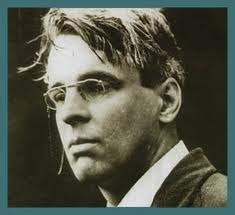
W.B.Yeats. Father of The Celtic Revival.


W.B. Yeats and his promotion of Irish heritage, early work up to 1900.


“Whose tales seem fragrant with turf smoke”


William Butler Yeats 1865-1939

Yeats was born into a protestant Anglo-Irish landowning class; Anglo-Irish Protestant groups supported a literary revival whose writers wrote in English about the ancient myths and legends of Ireland. Most members of this minority considered themselves English people who happened to be born in Ireland, Yeats however, was adamant in affirming his Irish nationality. He lived in London for many years during his childhood and even kept a home there in his adult life but he never forgot his cultural roots.

He became involved with the Celtic Revival; this was a movement that sought to promote the spirit of Ireland’s heritage against the cultural influences of English rule in Ireland during the Victorian period. Although Yeats never learned the Irish tongue himself he drew extensively from the language and the ancient Irish myths, legends, and folklore to reveal the connection between those traditions, the individual, and the nation and by understanding this connection he came to realise the true reality that was hidden from those who failed to see it.

In 1885, Yeats met the Irish nationalist John O'Leary, who was instrumental in arranging for the publication of Yeats's first poems in The Dublin University Review and in directing Yeats's attention to native Irish sources for subject matter. Under the influence of O'Leary, Yeats took up the cause of Gaelic writers at a time when most of the native Irish literature was in danger of being lost as the result of England's attempts to anglicise Ireland through a ban on the Gaelic language.

Yeats believed that the “de-Anglicising" of Ireland did not depend on the preservation of its literature in the Gaelic language. He wanted writers to translate the tales of the history and heritage of Ireland into English whilst retaining the best of ancient Irish literature that was represented in its rhythm and style. He also wanted to build a bridge between the two and write about the histories and romances of the great Gaelic heroes and heroines of the past. Yeats said “let us make those books known to the people” it was his belief that this would do more to “de-Anglicise” Ireland than clinging to the Gaelic tongue of yesteryear. Yeats accepted that the teaching of Irish played a part in our heritage but that we should not base our hopes of nationhood upon it. He said “Remember it is the tales of Cú chulainn and of Deirdre of the sorrows that are immortal and not the tongue that first told them”.

W. B. Yeats became the champion of Celtic culture and his poetry was a celebration of all things Gaelic. Irish legend gave Yeats a way to be something more than a symbolist (Brown, 2001, p83). He wrote in a letter to the French critic and journalist Henry Davray on19th March 1896, that “I am an Irish poet looking to my own people for my ultimate best audience and trying to express the things that interest them and which will make them care for the land in which they live”.

He was devoted to the cause of Irish nationalism and promoted Irish heritage through his use of material from the ancient sagas within his poetry. The publication in 1889 when Yeats was twenty-four of The Wanderings of Osian which was based on the legend of an Irish hero was a defining moment, not only in Irish literary history, but also its political history. Yeats's book, based on the Fenian cycle, brought Irish mythology to the Irish people in English -'the language' as he pointed out 'in which modern Ireland thinks and does its business’. He also published several volumes of poetry during this period, notably Poems (1895) and The Wind Among the Reeds (1899), which also demonstrated his use of Irish folklore and legend.

Yeats knew that many Irish people of the time did not have the benefit of an education and what little they did have was heavily influenced by the Catholic church, a church that believed in the teaching of the Irish language whether you wanted to learn it or not. He also believed, as did most of the protestant writers of the Celtic Revival that the Catholic Church had no desire for the teaching of myth, legend, and folklore which they saw as promoting a belief in pagan gods. In what could be seen as arrogance, Yeats saw himself as the father of the Celtic Revival and because of this he incorporated folklore and myth into his works.

The feeling I get when I read some of Yeats poetry is sadness, as if he is lamenting a time long gone. He seems to be looking for somewhere that no longer exists, and this comes through in such poems as The Stolen Child who yearns to escape from a place that is “more full of weeping than you can understand” or The Lake Isle of Innisfree in which he yearns to escape from the chaos and corruption that surrounds him to a place of peace and tranquillity. Maybe this is symbolic of the turmoil he feels as Yeats writings are so full of symbolism. In his autobiography, Yeats writes that his poem was influenced by his reading of American writer Henry David Thoreau’s Walden (1854), which describes Thoreau’s experiment of living alone in a small hut in the woods on Walden Pond, outside Concord, Massachusetts. Yeats warns that failing to look at ourselves as others see us, 'we may go mad someday' (revolt?) and the English will destroy the beautiful Celtic culture and replace it with what they will. Yeats died in 1939 and although buried in France his body was eventually returned to Ireland and is now buried in the Protestant churchyard, Drumcliff, Co. Sligo. Ironically the person in charge of this operation for the Irish Government was Sean MacBride, son of Maud Gonne MacBride.

Bottom image: Yeats gravestone in Drumcliff graveyard with the inscription “Cast a cold eye on life, on Death, Horseman pass by”

Wednesday, November 23, 2011

Padraig Pearse. Irish Patriot.


Patrick Henry Pearse.

Born: November 10, 1879 in Dublin
Died: May 3, 1916 in Dublin

Patrick Henry Pearse (Padraig MacPiarais) is known as an Irish patriot, scholar, teacher and poet. He was a student of literature and history and wanted to free Ireland from the rule of the British. In 1908, he established St. Edna’s College to educate young Irish citizens about Irish customs, language, and beliefs. Pearse was a key figure in organizing the Easter Rising. He had been an active member of the Irish Republican Brotherhood and was named an affiliate of its Supreme Council. He wrote a number of position papers and poems to express his intellectual and emotional feelings about the pursuit of Irish freedom. Perhaps the most memorable of these is “Mise Éire”:


“Mise Éire” (in Irish first)

Mise Éire
Sine mé ná an Chailleach Bhéarra.
Mór mo ghlóir:
Mé a rug Cúchulainn croga.

Mór mo náir:
Mo chlann féin a dhíol a máthair.
Mise Éire:
Uaigni mé ná an Chailleach Bhéarra.


“I am Ireland”

I am Ireland:
I am older than the Old Woman of Beare.
Great my glory:
I that bore Cuchulainn the valiant.

Great my shame:
My own children that sold their mother.
I am Ireland:
I am lonelier than the Old Woman of Beare.

In this poem Pearse describes Ireland’s struggle using familiar themes. He sees Ireland as an old woman who once experienced the glory of having a son who stood against the invader. He was the mythical warrior Cú Chulainn who even when mortally wounded strapped himself to a rock in order to remain standing and continued to fight. However, the old woman also experienced shame as she sees her children sell her to the invaders, a story as old as Ireland herself. Our history is rife with tales of betrayal from within our own ranks.

Pearse hopes to rouse nationalist feelings by drawing on mythology and the concept of Ireland as a defenceless old woman. Pearse, by including her in Mise Eire introduces a feeling of bitterness, something that you see more and more off as you read his poetry but it is also rich in symbolism as he also uses the figure of Cú Chulainn, the archetypal Celtic war hero, as symbolic of the kind of figure that a faltering Irish culture needed to resist the occupying influences, to restore the traditional values of Irish life which Pearse would once again have experienced in Connemara.

Interestingly, the figure of Cú Chulainn was eventually used to commemorate the Easter Rising both in a statute in the Dublin GPO and on the old Irish ten shilling coin (in 1966). Mise Eire is a sad poem, raising as it does many different feelings in the reader. A story of an old mother deserted and sold to Britain who laments her loneliness.

From the cradle to the grave.

There is also a certain irony in Pearse’s life. It is as if An Chailleach Bhéarra, the old hag of mythology has reached out from the mist of time and placed a hand upon his shoulder. Perhaps on Nov. 10, 1879, at 27 Great Brunswick St., Dublin, as the mother and father looked down at their newborn son, they had an idea of what his future held. That may explain why they named him Patrick Henry Pearse. Their son would grow to be the embodiment of the words of the American patriot Patrick Henry, who said in the Virginia Convention on March 23, 1775: "I know not what course others might take, but as for me, give me liberty or give me death!" These words would have been an appropriate epitaph on the gravestone of Pearse, the leader of the Easter Rising 1916. The final irony for Pearse was that his father was a stonemason and Patrick Henry Pearse was to end his life in the stone breakers yard of Kilmainham Prison.

The lower image is of the stone breakers yard where Pardraig Pearse was executed.